Upper Lower Split: 4-Day Schedule, Sets and Session Times
An upper lower split alternates upper-body and leg days, usually four a week: Upper, Lower, rest, Upper, Lower. Each major muscle group gets two sessions a week, as ACSM recommends for intermediates on this split. By our arithmetic, the sample plan's longest day runs 68 minutes; moving two arm lifts to leg days brings every session under an hour.
On this page
An upper lower split gives each muscle two sessions a week
The week has two kinds of day. Upper days train chest, back, shoulders, biceps and triceps. Lower days train quads, hamstrings, glutes and calves. You run two versions of each, A and B, with different lifts.
| Day | Session |
|---|---|
| Monday | Upper A |
| Tuesday | Lower A |
| Wednesday | Rest |
| Thursday | Upper B |
| Friday | Lower B |
| Saturday and Sunday | Rest |
The American College of Sports Medicine's 2009 position stand recommends four days a week for intermediate lifters using an upper/lower split, so each major muscle group is trained twice. For novices, it recommends training the whole body 2–3 days a week. If you are brand new, a three-day full-body start comes first.
A 4-day upper lower plan with sets per muscle counted
Here is a sample plan to copy. Big lifts come first and single-joint lifts last, one of the orders ACSM's position stand recommends. Reps are a range, so you can add weight by double progression.
| Day | Exercises (sets × reps) | Sets |
|---|---|---|
| Upper A | Bench press 4 × 6–8, chest-supported dumbbell row 4 × 8–10, seated dumbbell shoulder press 3 × 8–10, pull-up 3 × 6–10, incline dumbbell curl 3 × 10–12, lying triceps extension 3 × 10–12 | 20 |
| Lower A | Back squat 4 × 5–7, Romanian deadlift 3 × 8–10, leg extension 3 × 12–15, standing calf raise 3 × 10–15 | 13 |
| Upper B | Incline dumbbell press 4 × 10–12, seated cable row 3 × 10–12, lateral raise 3 × 12–15, hammer curl 3 × 10–12, triceps pushdown 3 × 12–15 | 16 |
| Lower B | Leg press 4 × 10–12, hip thrust 3 × 8–12, lying leg curl 3 × 10–12, seated calf raise 3 × 12–15 | 13 |
That is 62 working sets a week. Count them per muscle, giving each exercise to one muscle:
- Quads 11: squat 4, leg press 4, leg extension 3.
- Back 10: dumbbell row 4, pull-up 3, cable row 3.
- Chest 8: bench press 4, incline dumbbell press 4.
- 6 each: shoulders, biceps, triceps, hamstrings and calves, from two lifts of 3 sets.
- Glutes 3: hip thrust. Squats and Romanian deadlifts train them too, but they are counted elsewhere.
Whether 8 chest sets is enough has its own guide: how many sets per muscle group per week, including why the counting rule changes the answer.
If upper days run long, put arms on leg day
Upper A has 20 sets and Lower A has 13. The upper day carries five muscle groups, so it is the one that drags. To see by how much, we worked out each session's length from five working numbers of our own:
- 1 minute per set, counting setup.
- 3 minutes of rest after bench press and squat sets. For strength, ACSM recommends at least 2–3 minutes for heavy core lifts.
- 2 minutes after other compound lifts, hip thrust included, and 1 minute after single-joint lifts, the low end of the 1–2 minutes ACSM says may suffice for assistance exercises.
- 10 minutes of warm-up, and a rest counted after every set, including the last, for changing stations.
So bench press is 4 sets × (1 + 3) minutes = 16 minutes. Add every lift the same way and you get the first column below. For the second column, move the incline dumbbell curl to Lower A and the lying triceps extension to Lower B.
| Session | As written | Arm lifts on leg days |
|---|---|---|
| Upper A | 68 min (20 sets) | 56 min (14 sets) |
| Lower A | 47 min (13 sets) | 53 min (16 sets) |
| Upper B | 49 min (16 sets) | 49 min (16 sets) |
| Lower B | 43 min (13 sets) | 49 min (16 sets) |
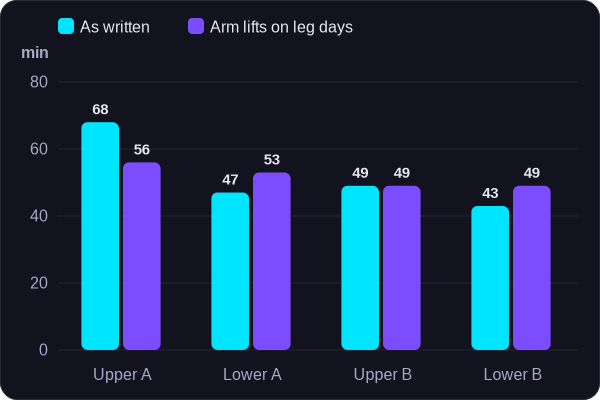
The gap between the longest and shortest day falls from 25 minutes to 7, and every session ends under an hour on these numbers. Nothing is lost: biceps and triceps still get two sessions and 6 sets each a week. Do the arm lift last on the leg day, after the big lifts.
One side effect: triceps now train Thursday and Friday in a row.
Common mistake: Fixing a long upper day by cutting chest or back sets. That lowers your weekly volume, and a 2017 meta-analysis of 15 studies linked more weekly sets per muscle to more growth. Our working rule: move sets first, cut them last.
Your pace will differ from these numbers. Shorter rests shorten every day: for muscle growth, ACSM recommends 1–2 minutes for novice and intermediate lifters. Time one week of your own sessions and redo the sums. If your rests run longer, how long to rest between sets sets out what the guidelines and trials say.
Upper lower split on 3, 5 or 6 days a week
Keep the same four sessions and change how often they come round. On 3, 5 or 6 days, run them as a rotation: the four sessions in order, so each week starts where the last one ended.
| Days a week | Layout | Sessions per muscle a week | Chest sets a week |
|---|---|---|---|
| 3 | Rotation, e.g. Mon, Wed, Fri | 1.5 on average (2 and 1 in turn) | 6 on average (8 and 4 in turn) |
| 4 | Mon, Tue, Thu, Fri | 2 | 8 |
| 5 | Rotation, five days on | 2.5 on average (3 and 2 in turn) | 10 on average (12 and 8 in turn) |
| 6 | Rotation, six days on, one rest day | 3 | 12 |
The chest column is sessions times sets: each upper day in the plan has 4 chest sets, so 1.5 upper days a week gives 6. More days mostly buys more weekly sets. A push pull legs split needs six days to train each muscle twice, while a bro split usually trains each body part on one day of a five-day week.
For muscle growth, the number of sessions matters less than the sets. A 2019 meta-analysis of 25 studies found similar growth across frequencies when weekly volume was equal, and its authors say frequency can follow preference. In studies where volume was not equal, higher frequencies did modestly better, and the rows above differ in volume.
Strength may be different. A 2026 meta-regression of 67 studies suggests strength gains rise with frequency, with diminishing returns, while frequency's effect on growth was compatible with a negligible one. Its authors note that they coach and write in the fitness industry.
Missed a day? Our working rule: on a rotation, do the session that was next. On fixed weekdays, push the missed session and the ones after it back a day until a rest day absorbs the shift, or skip it and carry on.
How to track progress on an upper lower split
Each session repeats once a week on four days, so your log compares this Monday with last Monday. Five habits keep that comparison honest:
- Log every working set. Weight and reps, as in how to log workouts.
- Keep A and B lifts apart. Bench press lives on Upper A and incline press on Upper B, so each lift's last session is the same session a week ago.
- Add weight at the top of the range. Bench 4 × 6–8 at 70 kg (154 lb): once all four sets reach 8, add 2.5 kg (5.5 lb). That trigger is our working rule. For lifters training to a rep target, ACSM recommends adding 2–10% once you beat it by one or two reps on two sessions in a row. The lower end is for small-muscle lifts, the higher for big ones; 2.5 kg is 3.6% of 70 kg.
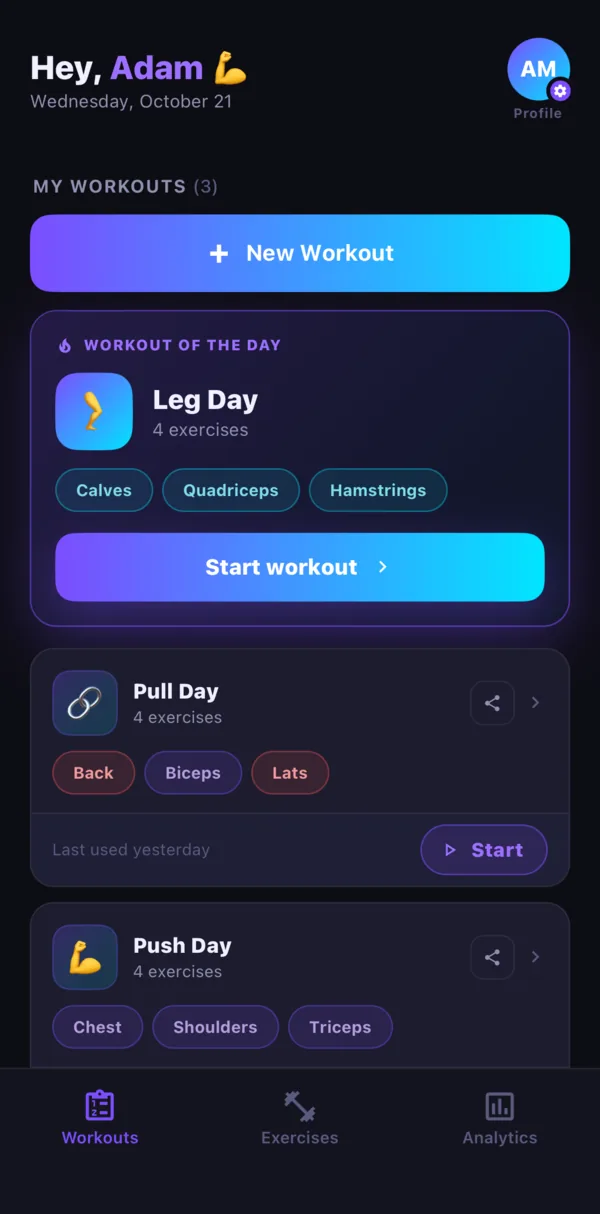
- Check sets per muscle once a month. In Lifter Log, Muscle balance in the Analytics tab shows sets per muscle group for the period, plus the groups you haven't trained lately. It counts each exercise toward its own muscle group, so your totals match this page only if your exercises are tagged the same way.
- Measure size every few weeks. Lifts can rise faster than muscles grow, as how to track muscle growth explains. Tape your arms and thighs, as in how to track body measurements.
Our working rule for judging the plan: if one lift stops moving for three sessions in a row, change one thing on that lift, not the whole split. The plateau guide covers how to confirm a stall.