How to Track Muscle Growth: Lifts, Tape and Waist Together
To track muscle growth, check three things every four weeks: top sets at the same reps, arm and thigh on a tape, and your waist. Our rule: growth is likely when lifts and limbs rise while the waist holds. In this 12-week example: bench up 7.5 kg (16.5 lb), arm up 1.5 cm (0.6 in), waist flat.
On this page
- How to track muscle growth: three checks every four weeks
- Your lifts can rise faster than your muscles
- Measure your arm for growth and your waist for fat
- A 12-week log where the signals disagree, then agree
- Body scans: trust a muscle change only past the noise
- Keep all three checks in Lifter Log
- FAQ
How to track muscle growth: three checks every four weeks
No single number you can measure at home shows muscle directly. Each one sees part of the picture, and each one can fool you on its own. Read them together and they cover each other's blind spots.
- Lifts at the same reps. Log every set. Every four weeks, compare the top set of two or three main lifts at the same rep target, such as 8 reps.
- Arm and thigh tape. Every four weeks, measure your flexed arm and your thigh, the same side and the same spot each time. Take two passes and log the average.
- Waist. In the same session, measure your waist. It is your fat check, because the tape on your arm can't tell muscle from fat.
A scan is an optional fourth check. An InBody or DEXA scan every few months adds a split of fat and lean mass.
| Check | What it sees | How it misleads alone |
|---|---|---|
| Lifts | Strength at a rep target | Strength can rise faster than size |
| Arm and thigh | Size at one site | Can't split muscle from fat; early swelling |
| Waist | Whether your middle grows too | Says nothing about muscle by itself |
| Scan | Fat and lean mass | Day-to-day noise, water and glycogen |
The four-week pace and the waist check are a working routine, not a protocol from a study. The sections below give the papers behind each check, and how to read the checks when they disagree.
Your lifts can rise faster than your muscles
Strength is the easiest signal to collect, and it can run ahead of the truth. In one small study, seven young adults did flywheel leg extensions three times a week. After 35 days their maximal strength was up 38.9%, while thigh muscle size was up 6.5% and 7.4% in the two regions measured (Seynnes et al., 2007).
Larger pooled data show the same gap. The data covered 287 untrained men and women aged 19 to 78 who trained for 20 to 24 weeks, plus 72 non-training controls. The trainees gained 21.1% in strength and 4.8% in muscle size on average (Ahtiainen et al., 2016).
The size changes ranged from −11% to 30% in the same data (Ahtiainen et al., 2016), so your pace may differ a lot from anyone else's.
So a rising bench is a good sign, not proof of muscle. Two habits make it a fairer signal:
- Compare like with like. The same exercise, the same rep target, the same setup. A top set of 85 kg × 8 (187 lb) beats 80 kg × 8 (176 lb). A heavier set of 5 isn't the same comparison.
- Count reps as progress too. 80 kg for 10 reps instead of 8 counts as progress. How to track progressive overload covers the log, and how to break a strength plateau covers lifts that stall.
If your rep targets change, an estimated one-rep max lets you compare a set of 5 with a set of 8. The 1RM calculator does it by hand.
Measure your arm for growth and your waist for fat
A tape measure is crude, but it can see growth. Researchers pooled data from three studies of 67 young men, some trained and some not, who lifted for 10 to 12 weeks. Flexed upper-arm circumference rose 4.9% and ultrasound muscle thickness 3.9% (Gentil et al., 2020).
The authors conclude both can detect the change, but the size of the change may differ, so take care when you compare or combine the two.
The tape has one big blind spot: a bigger arm could be more muscle or more fat. That is the waist's job. If your arm grows while your waist holds steady, fat is a less likely explanation. If both grow, some of the new size may be fat. That reading is our working rule, not a study result.
Before you trust any change, find your own repeat spread. Measure one site three times, say 35.0, 35.5 and 35.0 cm on your arm. The spread from lowest to highest is 0.5 cm (0.2 in). As a working rule, treat a change smaller than that as noise. This spread comes from one sitting, so day-to-day swings add more.
The full routine for each site is in how to track body measurements.
Common mistake: Counting the first month's tape gain as muscle. In ten untrained young men, the cross-section of one thigh muscle, measured by ultrasound, was up about 2.7% by week 3 and 10.4% by week 10 (Damas et al., 2016). The authors propose that swelling, probably from muscle damage, may account for a large part of the early rise.
Our working rule: judge the tape from week 8 onward.
A 12-week log where the signals disagree, then agree
Here is one lifter's log, with illustrative numbers. The bench and squat are top sets at 8 reps. The arm is flexed, right side, with a repeat spread of 0.5 cm. The thigh and waist each have a spread of 1.0 cm.
| Check | Week 0 | Week 4 | Week 8 | Week 12 |
|---|---|---|---|---|
| Bench, top set × 8 | 80 kg (176 lb) | 82.5 kg (182 lb) | 85 kg (187 lb) | 87.5 kg (193 lb) |
| Squat, top set × 8 | 100 kg (220 lb) | 102.5 kg (226 lb) | 105 kg (231 lb) | 107.5 kg (237 lb) |
| Arm, flexed | 35.0 cm (13.8 in) | 35.5 cm | 35.5 cm | 36.5 cm (14.4 in) |
| Thigh | 58.0 cm (22.8 in) | 58.5 cm | 59.0 cm | 59.5 cm (23.4 in) |
| Waist | 84.0 cm (33.1 in) | 84.0 cm | 84.5 cm | 84.0 cm (33.1 in) |
Against week 0, the arm reads +0.5, +0.5 and +1.5 cm, the thigh +0.5, +1.0 and +1.5 cm, and the waist 0, +0.5 and 0 cm.
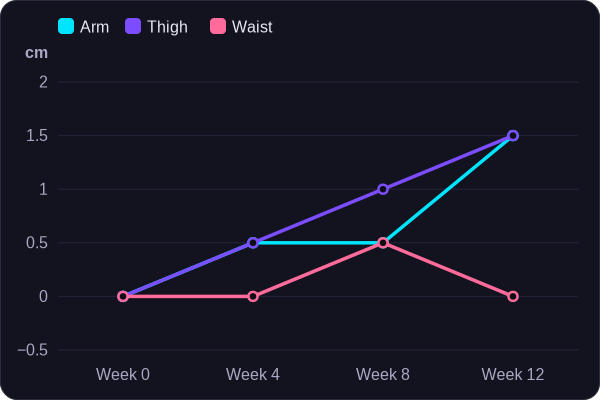
- Week 4: strength only. The bench and squat are each up 2.5 kg (5.5 lb). The arm moved 0.5 cm, exactly its spread, and inside the early swelling window. Nothing to read yet.
- Week 8: the lifts lead. The bench and squat are each up 5 kg (11 lb), but the arm hasn't moved since week 4. The thigh's +1.0 cm only matches its spread, and the waist's 0.5 cm rise is half its spread. This is the gap the studies above describe, so keep going.
- Week 12: the signals agree. The arm is up 1.5 cm (0.6 in), three times its spread, and the bench is up 7.5 kg (16.5 lb). The thigh's 1.5 cm is 1.5 times its spread, with the squat up 7.5 kg (16.5 lb), a promising direction. The waist is back where it started.
That last line is the pattern you want: lifts and limbs up, waist flat. The arm's 1.5 cm on 35.0 cm is about 4.3% (our arithmetic). That is close to the 4.9% average for the young men in the 10-to-12-week arm study above.
What each mix of signals means
Your log won't always line up this neatly. Here is how to read the common mixes, as a working rule:
| Lifts at same reps | Arm or thigh | Waist | Likely reading |
|---|---|---|---|
| Up | Up past spread | Steady | Muscle is the likely story |
| Up | Steady | Steady | Strength ahead of size; give it 4 to 8 weeks |
| Up | Up | Up | Some of the new size may be fat |
| Steady | Up | Up | More likely fat than muscle |
| Steady | Steady | Steady | No sign of growth yet; check your sets |
For the last row, start with how many sets per muscle group per week. More weekly sets were linked to more growth in the studies it covers.
Body scans: trust a muscle change only past the noise
A scan splits your weight into fat and lean mass, which the tape can't. Its weakness is noise, so a small change can mean nothing:
- InBody. A lab study of the InBody 770 scanned 14 fit adults ten times over three weeks. Each person's skeletal muscle reading spread over about 1.0 kg (2.2 lb) on average (Looney et al., 2024). How to read InBody results works through it.
- DEXA. A study scanned 21 trained adults a day apart. A change had to beat about 0.4 kg (0.9 lb) of lean mass in both arms and 1.1 kg (2.4 lb) in both legs (Zemski et al., 2019). The arms and legs are mostly muscle, while the trunk includes your organs. See how to read DEXA results.
Use the same machine and the same morning routine every time. In our reading, a scan agrees with your tape when muscle rises past those margins while fat mass holds or falls. On an InBody, that means skeletal muscle; on a DEXA, arm and leg lean mass.
Quick check: if a scan shows a muscle gain that your lifts and your arm tape don't, wait for the next scan before you believe it.
Keep all three checks in Lifter Log
In Lifter Log, each exercise opens with last session's sets filled in, so you adjust and save. Its charts show top-set weight and total reps over your recent sessions, and Analytics, then Strength & PRs, shows an estimated 1RM trend for each lift once it has three points.
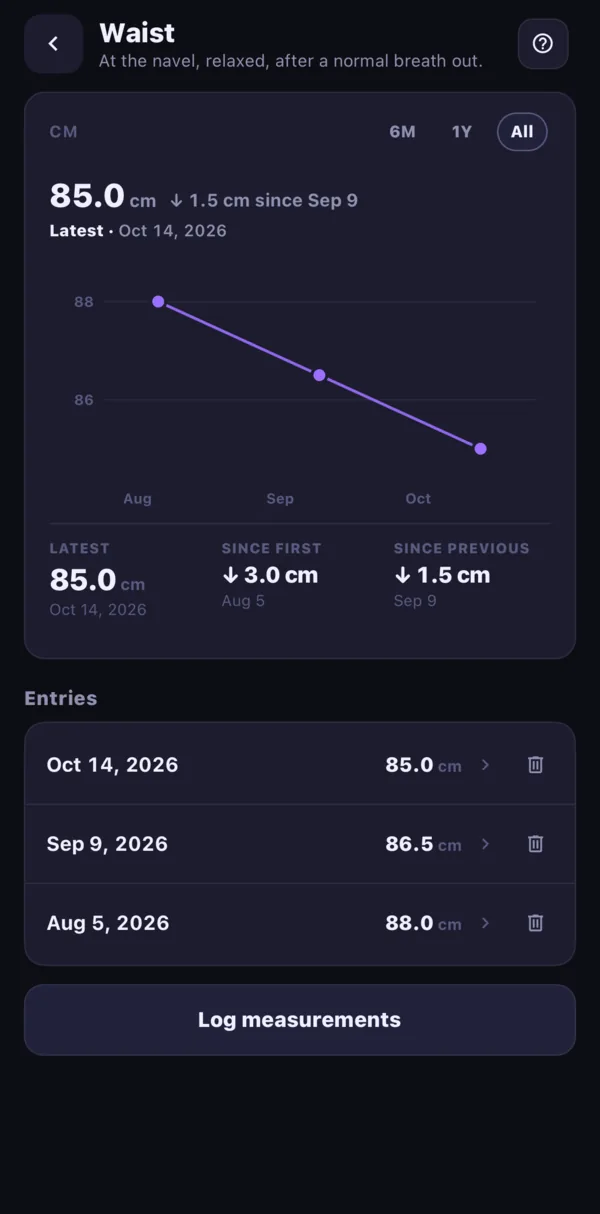
The tape lives under Analytics, then Body. Biceps, thighs and waist are among the sites tracked by default, and biceps and thighs take a left and a right value.
Snap a photo or upload a PDF of your InBody or DEXA report, and the AI reads it and charts muscle and fat from scan to scan. See the body section of the site.
It logs numbers, not progress photos. If you take photos, keep them in your camera roll, in the same light and pose each time.