Getting Back Into the Gym After a Break: How Light to Start
Our rule for getting back into the gym after a 3-week to 3-month break: start at 90% of your last weights, rounded down. Add 2.5 kg (5 lb) a session on main lifts while every set makes its reps, up to your old weights. In a 2024 trial, novices regained a 10-week break's losses within 5 weeks of training.
On this page
- How much strength you lose depends on how long you stop
- Getting back into the gym after a break: your log first
- Start at 90% after 3 weeks to 3 months off
- Add 2.5 kg a session on main lifts while all sets make reps
- Train 2 or 3 days a week for a month and until you're back
- Once you're back at your old numbers, progress as usual
- FAQ
Under 3 weeks off, start at your last weights. After more than 3 months, up to a year, start at 80%. After more than a year, find your weights fresh. All four are our working rules, set out in the table further down.
How much strength you lose depends on how long you stop
In one study, two weeks off left trained men's leg press strength where it was. In another, ten weeks off cost novices 5.4% of their leg press 1RM on average. Short breaks cost little, and longer ones cost more:
| Break | Who | What happened |
|---|---|---|
| 2 weeks | 20 trained young men (Hwang, 2017) | Leg press strength did not drop |
| 3 weeks, twice in 24 weeks | 14 young men new to lifting, bench press only, split into a group with breaks and one without (Ogasawara, 2013) | Gains in muscle size and strength were similar to a group that trained straight through, on 18 weeks of training instead of 24 |
| 10 weeks | Adults new to lifting, after 10 weeks of training: 28 began this group, 20 finished (Halonen, 2024) | On average, leg press 1RM fell 5.4%, curl 1RM 3.6%, a thigh muscle's size 9.9% and biceps size 7.3%. All four were back to pre-break levels after 5 weeks of training |
| Many lengths | A meta-analysis of 103 studies (Bosquet, 2013) | Losses grew with the length of the break and were larger in people over 65 |
Read the 10-week row with its limits. The lifters were aged 18 to 40 and new to lifting. They trained twice a week, mostly on machines, and were tested on a machine leg press and a barbell curl. Even after the break, all four measures stayed above where they were before training began.
Size fell more than strength in the legs, and the arms trended the same way. So you may look smaller before you are much weaker.
Except for the meta-analysis, no study here tested a break longer than 10 weeks. Of the three single studies, only the 2-week one tested trained men. So the time-off table further down is our working rule, not study data.
Getting back into the gym after a break: your log first
Your first weights come from the last weights you lifted, so find them before you load a bar. For each main lift, look up your last working sets: the weight, the sets and the reps.
- In a training app, open each exercise's history. In Lifter Log, every exercise opens with the sets you saved last time, which after a break means your last session before it.
- In a notebook or a phone note, turn back to the last week you trained. Lifter Log's AI import reads up to 8 photos, a spreadsheet, a PDF or another app's CSV export, and dated sets and reps come in as history. Check a few against the page, since accuracy depends on the source.
- With no log at all, our working rule is to treat it like a break of over a year. Find your weights fresh, as in a first month of strength training.
Common mistake: Loading your old working weight because it's the number in front of you. After 3 weeks or more off, that number is the target you climb back to, not your first set.
Start at 90% after 3 weeks to 3 months off
Our working rule sets your first weights by the length of the break. Keep each exercise's sets and reps from before. Only the weight changes.
| Time off | First working weight (our rule) |
|---|---|
| Under 3 weeks | Your last weight, then your usual progression |
| 3 weeks to 3 months | 90% of your last weight |
| Over 3 months, up to a year | 80% of your last weight |
| Over a year, or no log | Find it fresh in session 1, as a beginner would; your old numbers are the target |
- Round down to a weight you can load. 90% of 82.5 kg is 74.25 kg, so start at 72.5 kg. In pounds, 90% of 185 lb is 166.5 lb, so start at 165 lb.
- Over 65? Use the next row down. The meta-analysis above found larger losses after 65.
- Missed reps in session 1? Drop another 5% of your old weight (say, 85% instead of 90%), round down and start the climb from there.
Why 90%: the 2024 trial's average loss was 5.4% on the leg press, so a 10% cut is nearly double that (our arithmetic). Losses varied a lot from person to person, so some lost more than the average. The trial measured 1RM, not sets of 5 or 8, so treat the margin as a rule of thumb.
The under-3-weeks row follows the 2-week study above; a 3-week break already starts in the 90% row. A planned deload week falls in the under-3-weeks row. The 80% row doubles that cut for longer breaks, and no study here tested it.
Add 2.5 kg a session on main lifts while all sets make reps
Here is a worked example we made up for this page. A lifter took 10 weeks off. Before the break, their last squat was 100 kg (220 lb) for 3 sets of 5. Their last bench press was 80 kg (176 lb) for 3 sets of 5. They come back on two full-body sessions a week.
- Session 1 at 90%. The squat starts at 90 kg (198 lb). The bench works out at 72 kg, which rounds down to 70 kg (154 lb).
- Add 2.5 kg (5 lb) next session when every set made 5 reps. On a light lift such as a curl, use your smallest jump instead.
- Hold the weight if any set fell short, and try it again next session.
- Stop the climb at your old weight and go back to your usual progression.
| Session | Squat, 3 × 5 | Bench, 3 × 5 |
|---|---|---|
| 1 (week 1) | 90 kg: 5, 5, 5 | 70 kg: 5, 5, 5 |
| 2 (week 1) | 92.5 kg: 5, 5, 5 | 72.5 kg: 5, 5, 5 |
| 3 (week 2) | 95 kg: 5, 5, 5 | 75 kg: 5, 5, 5 |
| 4 (week 2) | 97.5 kg: 5, 5, 4 | 77.5 kg: 5, 5, 5 |
| 5 (week 3) | 97.5 kg: 5, 5, 5 | 80 kg: 5, 5, 5 (back) |
| 6 (week 3) | 100 kg: 5, 5, 5 (back) | Usual progression |
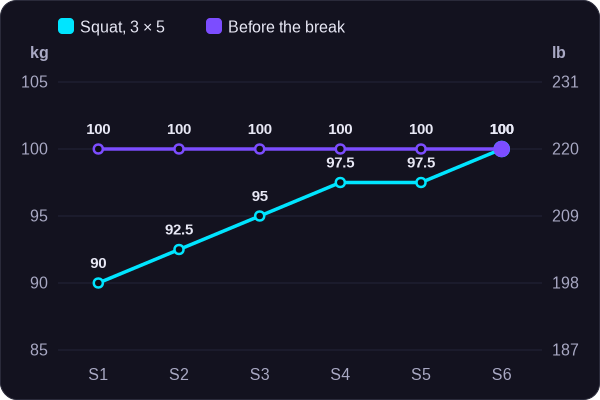
The bench was back in 5 sessions and the squat in 6, both inside 3 weeks at two sessions a week (our arithmetic). The missed rep in session 4 cost the squat one session.
A longer break starts lower, so the climb takes more sessions. From 80%, a 100 kg squat needs 8 jumps of 2.5 kg. In a pound gym it works the same way: 90% of 225 lb is 202.5 lb, so start at 200 lb and add 5 lb a session.
Train 2 or 3 days a week for a month and until you're back
Two supervised full-body sessions a week was the whole program in the 2024 trial. Each session was five exercises of 3 or 4 sets of 8 to 10 reps, with 2 minutes of rest. That was enough to regain what the break took within 5 weeks.
Our working rule: come back on two or three full-body days for at least the first month, and until your main lifts are back. That holds even if you trained five days a week before. Then return to your split, whether that's upper/lower, push/pull/legs or a bro split. How many days a week to lift has the ranges by experience.
The habit comes back on a schedule too. Put the sessions on fixed days and keep the gaps short, as in how to stay consistent at the gym. In Lifter Log, a workout scheduled for today waits at the top of the Workouts screen, and Analytics shows your sessions per week, your streak and a calendar.
Once you're back at your old numbers, progress as usual
The climb ends at your old weight. From there, add weight the way you did before the break, with double progression or the rule in how to track progressive overload.
Each exercise's top-set weight chart shows about your last 8 sessions, so the dip and the climb can sit side by side. When a top set beats your all-time best on a lift, Lifter Log flags a New PR. If you stopped at your best, that flag marks the day you passed where you stopped.
Quick check: If the break was for an injury, an illness, surgery or a pregnancy, see a qualified professional before you use these numbers. The 2024 trial's authors say their results don't apply directly to breaks caused by illness or injury.