Double Progression Method: How to Add Reps, Then Weight
Double progression means you progress reps first, then weight. Pick a rep range such as 6–10 and add reps at the same weight each session. When every set reaches the top, add the smallest jump and build the reps back up. For example, 40 kg (88 lb) for 10, 10, 10 becomes 42.5 kg (94 lb) for 8, 7, 6.
On this page
How double progression works, step by step
You give each exercise two numbers to push, in a fixed order. Reps go up first. Weight goes up only when the reps have earned it. It turns a guideline from the American College of Sports Medicine into a routine. When you can beat your target by one or two reps, add 2–10% to the load (ACSM, 2009).
- Pick a rep range. For example 3 sets of 6–10. The bottom number is your floor, the top number is your target.
- Pick a starting weight. Use one you can lift for at least the bottom of the range on every set, with good form.
- Add reps each session. Same weight, one more rep on any set you can.
- Jump when every set hits the top. All three sets at 10 means you've earned it. Add the smallest jump the lift allows.
- Build the reps back up. The heavier weight drops you toward the bottom of the range. Climb again.
Which range? ACSM's guideline suggests 8–12 reps for beginners. For experienced lifters it suggests an emphasis on heavy loads of 1–6 reps for strength, and 6–12 reps for muscle size.
In a meta-analysis of 21 studies, loads above 60% of max built more one-rep-max strength than lighter ones. Muscle growth was similar with light and heavy loads when every set went to failure (Schoenfeld et al., 2017).
Common mistake: jumping the moment your first set reaches the top. If sets two and three are still at 8, the new weight will drop them below the floor. Wait for every set.
A double progression log: 7 sessions of overhead press
Here is one full cycle on the overhead press, 3 sets of 6–10, starting at 40 kg (88 lb). The weight stays put for five sessions. The reps do the climbing.
| Session | Weight | Reps | Total reps | What happened |
|---|---|---|---|---|
| 1 | 40 kg (88 lb) | 8, 7, 6 | 21 | Start. Every set is inside the range. |
| 2 | 40 kg | 9, 8, 7 | 24 | One more rep on each set. |
| 3 | 40 kg | 10, 9, 8 | 27 | First set reaches the top. |
| 4 | 40 kg | 10, 10, 9 | 29 | One set still to go. |
| 5 | 40 kg | 10, 10, 10 | 30 | Every set at 10. The jump is earned. |
| 6 | 42.5 kg (94 lb) | 8, 7, 6 | 21 | Plus 2.5 kg. Reps fall back, as expected. |
| 7 | 42.5 kg | 8, 8, 7 | 23 | Climbing again. |
Sessions 1 to 5 look flat if you only watch the bar. They aren't: total reps went from 21 to 30 at the same weight. That counts as overload. In an 8-week study of trained lifters, adding reps at a fixed weight built leg muscle about as well as adding weight did (Plotkin et al., 2022).
Session 6 is the part people misread. Total reps dropped from 30 to 21, but the weight went up 2.5 kg (5.5 lb). Judge the cycle by session 7 and later, not by the day of the jump. To keep the log honest, write every set's reps separately, never just "3×10".
Your rep range has to fit your smallest weight jump
Every jump costs reps, so your range has to be wide enough to absorb one. By the Epley formula, weight × (1 + reps ÷ 30), each 2.5% you add to the bar costs about one rep. That holds from roughly 6 to 12 reps.
So a range 2 reps wide, like 6–8, absorbs a jump of about 5%. A range 4 reps wide, like 6–10 or 8–12, absorbs about 10%.
That's why the press example uses 6–10. With 6–8, the jump from 40 kg for 8 would leave the first set at about 6 reps and the later sets probably below the floor.
| Lift and weight | Smallest jump | % of the weight | Reps it costs | A range that fits |
|---|---|---|---|---|
| Squat, 100 kg (220 lb) | +2.5 kg (5.5 lb) | 2.5% | About 1 | Any, even 4–6 |
| Bench press, 60 kg (132 lb) | +2.5 kg | 4.2% | About 1.5 | 6–8 or wider |
| Overhead press, 40 kg (88 lb) | +2.5 kg | 6.3% | About 2.5 | 6–10 or wider |
| Dumbbell curl, 12 kg (26 lb) | To 14 kg (31 lb) | 16.7% | About 6–7 | 8–15 |
| Lateral raise, 8 kg (18 lb) | To 10 kg (22 lb) | 25% | Too many to estimate well | Use a fix below |
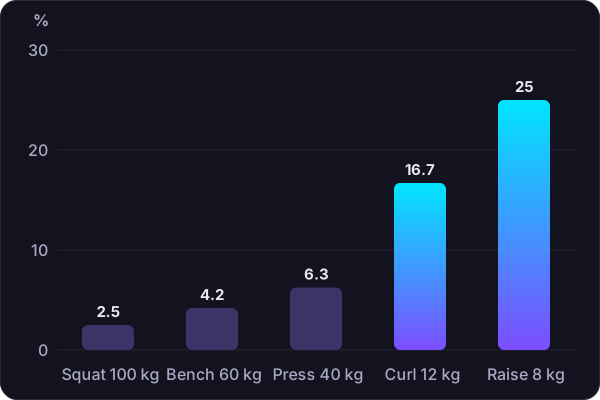
Treat the reps column as a ballpark, because lifts differ. In one study, men got more reps at 60% of their max on the back squat than on the bench press or arm curl (Shimano et al., 2006). The gap shrank at heavier loads, so the estimate is probably roughest for light weights and high reps.
The 1RM calculator runs Epley and two other formulas on your own sets.
Quick check: divide your jump by the weight on the bar and multiply by 100. Divide that by 2.5 to get the reps it costs. If the answer is bigger than your range is wide, the jump won't fit.
Four fixes when the jump is too big
- Widen the range. Curls at 8–15 instead of 8–12 give the 14 kg pair room to land.
- Use a smaller step. Fractional plates on a barbell (how to load a barbell shows the per-side math), or a cable or machine with a finer stack, if your gym has one.
- Add a set first. A fourth set at the same weight is overload too, and how many sets per muscle group per week covers how many to run. Jump later, from a stronger base.
- Move one set at a time. That is dynamic double progression, below.
Dynamic double progression: each set earns its own jump
Basic double progression waits for your weakest set. The dynamic version lets each set move on its own. When a set reaches the top of the range, only that set goes up next session. Here is a cable row at 3 sets of 8–12, where the stack moves in 5 kg steps (10% at 50 kg, so about 4 reps):
| Session | Set 1 | Set 2 | Set 3 |
|---|---|---|---|
| A | 50 kg × 12 | 50 kg × 11 | 50 kg × 9 |
| B | 55 kg × 9 | 50 kg × 12 | 50 kg × 10 |
| C | 55 kg × 10 | 55 kg × 8 | 50 kg × 12 |
| D | 55 kg × 11 | 55 kg × 9 | 55 kg × 8 |
Set 1 moved up in session B. Under the basic rule it would have waited at 50 kg (110 lb) until set 3 caught up, two sessions later. By session D, all three sets are at 55 kg (121 lb), and set 1 is already at 11 reps.
The catch is bookkeeping: every set now has its own weight. A notebook line like "3×10 at 50" can't hold that, so log each set's weight and reps on its own row.
The dynamic version helps most when your later sets lose reps to fatigue, which your log will show. Basic double progression is simpler and works fine when your sets finish close together.
Double progression vs linear progression
Linear progression keeps the reps fixed and adds weight every session or every week, such as 3×5 with 2.5 kg more each time. Double progression lets the reps carry the progress between jumps.
| Linear progression | Double progression | |
|---|---|---|
| What changes each session | The weight | The reps, then the weight |
| When the weight goes up | On a fixed schedule | When every set hits the top of the range |
| Progress between jumps | None; the weight is the only lever | More reps at the same weight |
| What a stall looks like | Missed reps at the new weight | The same reps as last time, for several sessions |
Linear progression is fast while it lasts. The problem is that it asks for a heavier bar on a schedule, and ACSM notes you can't improve at the same rate over the long term.
Double progression slows the jumps to the pace your reps allow. When fixed jumps start failing, you can keep progressing at the same weight. For the bigger picture on choosing the lever, see how to track progressive overload.
What to do when your reps stop climbing
One bad session is noise. A practical line: three sessions at the same weight with no new rep anywhere is a stall. Before you change the plan, check the log for these:
- Rest. In one study of 15 young men, shorter rests cost reps over four sets of squat and bench (Willardson and Burkett, 2005). ACSM's guideline is at least 2–3 minutes for heavy sets of big lifts, and it says 1–2 minutes may be enough for assistance work. Rest the same each session.
- The exercise. A new grip, bench angle or machine is a new lift. Log it separately or the comparison breaks.
- The range of motion. Shallower reps aren't extra reps. Keep the standard fixed.
If the log is clean, change one thing. Take one jump off, back to the weight you last owned, and climb again. Or use a smaller jump, or a wider range from the table above. The tracking mistakes that hide progress cover the rest of the checklist.