How Many Reps to Build Muscle? 6 to 20, Close to Failure
How many reps to build muscle? A wide range works if sets end at or near failure. In a 21-study meta-analysis with every set to failure, light loads (60% of max or less) built muscle like heavy ones, which built more 1RM strength. Our default: 6–12 reps on big lifts, 10–20 on small, most sets 1–3 short of failure.
On this page
- How many reps to build muscle: light and heavy both work
- Sets near 20% of your max built less muscle
- Heavier sets build more one-rep max strength
- Our default: 6–12 reps on big lifts, 10–20 on small ones
- Stop most sets 1 to 3 reps short of failure
- Log every set and add weight at the top of the range
- FAQ
How many reps to build muscle: light and heavy both work
In trials that took every set to failure, sets from 3 reps (with more sets) to 35 reps built similar muscle, and heavy loads built more 1RM strength. That breaks the size part of the classic rep continuum: heavy sets for strength, about 8 to 12 reps for size and 15 or more for endurance.
Loads below are a share of each person's one-rep max (1RM), the most they can lift once. A 10RM is a weight you can lift 10 times and no more.
| Study, who | Compared | Muscle growth | Strength |
|---|---|---|---|
| Schoenfeld 2017, meta-analysis of 21 studies, each 6 weeks or longer | 60% of 1RM or less vs more than 60%, every set to failure | Similar | 1RM gains greater with heavy loads; isometric strength similar |
| Lopez 2021, network meta-analysis of 28 studies, 747 healthy adults; 19 of the 28 studies involved men, 21 involved untrained people | Light (more than 15RM), moderate (9–15RM) and heavy (8RM or less), sets to failure | No difference between loads | Heavy and moderate beat light; heavy vs moderate was not significant |
| Schoenfeld 2015, 18 trained young men, 8 weeks | 3 sets of 25–35 reps vs 8–12 reps on 7 exercises, 3 days a week, to failure | Similar. Light vs heavy: quads 9.5% vs 9.3%, elbow flexors 8.6% vs 5.3%, elbow extensors 5.2% vs 6.0% | Squat 1RM up 8.8% vs 19.6%, favoring 8–12 |
| Schoenfeld 2014, 17 trained young men, 8 weeks | 7 sets of 3RM with 3-minute rests vs 3 sets of 10RM with 90-second rests, volume matched | Biceps thickness: no significant difference | Bench press 1RM favored 3RM; a trend for the squat |
| Lasevicius 2018, 30 men, 12 weeks, twice a week | One arm and leg at 20% of 1RM, the other at 40, 60 or 80%, volume matched | The 20% limbs grew less than half as much; only 80% vs 20% was reported as significant | All loads gained; gains were larger at 60 and 80% |
Growth fell off only at the lightest load tested, 20% of max. Strength leaned toward the heavier load in every row that tested a 1RM, though not every gap was significant. Most of these lifters were men.
A 2021 review by Schoenfeld and colleagues puts the floor for similar growth at about 30% of 1RM. Above it, the authors conclude there is "no ideal hypertrophy zone".
So pick a rep count you can repeat and push hard, then count your hard sets.
A 2021 systematic review of 14 trials in trained adults found that counting sets to failure, or near it, seems an adequate measure of volume from 6 to 20-plus reps. That holds when other variables are kept the same. A set of 6 and a set of 20 can then count the same in our sets per muscle guide.
Sets near 20% of your max built less muscle
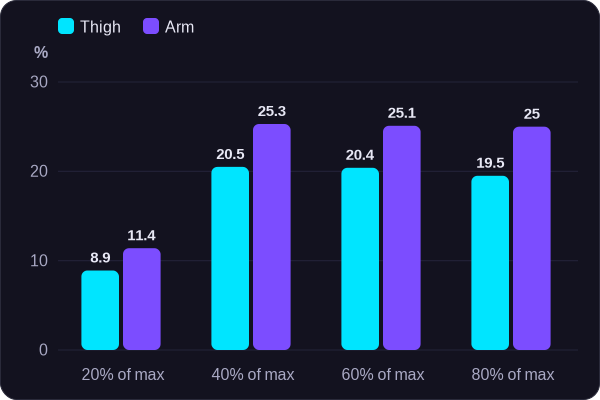
The lightest loads fall short. In Lasevicius 2018, each of 30 men trained one arm and one leg at 20% of 1RM, for 3 sets to failure. The other arm and leg trained at 40, 60 or 80%, with the number of sets adjusted so the total weight × reps matched.
After 12 weeks, the thigh muscle measured (vastus lateralis) grew 8.9% at 20%, against 20.5%, 20.4% and 19.5% at 40, 60 and 80%. The elbow flexors grew 11.4%, against 25.3%, 25.1% and 25.0%. The abstract reports only the 80% vs 20% gap as significant, and the authors judged 20% suboptimal.
How many reps is 20% or 30% of your max? It depends on the lift. In a 2006 study of 16 men, the same 60% load gave more reps on the squat than on the bench press or arm curl. No study here turns the floor into a rep count, so we use a working rule.
Quick check: Sets of 25 to 35 reps matched sets of 8 to 12 in Schoenfeld 2015. Sets of 30 to 40 did too in a 2016 preacher curl study of 21 young men in three groups of 7. Our working rule: if a set runs past 30 reps, add weight next time.
Heavier sets build more one-rep max strength
If you want a bigger squat, bench or deadlift max, the rep count matters more. In Schoenfeld 2014, 7 sets of 3RM built more bench press 1RM than 3 sets of 10RM, with similar biceps growth. In Schoenfeld 2015, squat 1RM rose 19.6% with 8–12 reps and 8.8% with 25–35.
ACSM's position stand recommends 8–12RM for beginners. Its abstract gives intermediate and advanced lifters 1–12RM, with eventual emphasis on heavy 1–6RM loads. Its body text splits strength advice by level: 60–70% of 1RM for 8–12 reps for beginners and intermediates, and loads of 80–100% for advanced lifters.
For muscle size, the body keeps beginners and intermediates at 8–12 reps; advanced lifters use 1–12RM, with most training at 6–12RM.
Both ends of the range have a cost:
- Heavy sets cost time. Worked out from the 2014 protocols, each exercise in the 3RM group meant 18 minutes of rest (six 3-minute rests). The 10RM group rested 3 minutes (two 90-second rests).
- Heavy sets may need more of them. The 2021 review says evidence suggests heavy loads need more sets for similar growth, and that heavy loads at high volume raise joint stress.
- Light sets tend to hurt more. They take many more reps, and the review notes the discomfort they tend to cause, which can hurt adherence.
Rest is its own question, covered in our guide to rest between sets.
Our default: 6–12 reps on big lifts, 10–20 on small ones
Pick the range by the lift's smallest weight jump: 6–12 where a plate is a few percent of the bar, 10–20 where the next light dumbbell is 25% heavier. If you have trained for a while and want a bigger max, add 3–6 on a main lift.
| Lift | Examples | Our range | Why |
|---|---|---|---|
| Big lifts, many joints | Squat, deadlift, bench press, rows, leg press, pulldowns | 6–12, or a band inside it such as 6–8 or 8–12 | A 2.5 kg jump is 2.5% of a 100 kg squat; a 5 lb jump is 2.2% of 225 lb |
| Small lifts, one joint | Curls, lateral raises, leg extensions, calf raises, pushdowns | 10–20 | The next dumbbell is a big jump: 8 to 10 kg is 25%, 15 to 20 lb is 33% |
| A strength goal on a main lift, experienced lifters | Squat, bench press or deadlift | 3–6, with more sets | ACSM cycles advanced lifters through 80–100% of 1RM for strength; heavier sets built more 1RM in the trials above |
Why the jump? ACSM suggests adding 2–10% to the load once you beat your target by one or two reps on two sessions in a row, with the lower end for small-muscle exercises.
A plate jump on a big lift fits inside that. Worked out by the Epley formula, 100 kg × 8 is about 102.5 kg × 7, so a 2.5% jump costs about one rep and a 6–8 band absorbs it. A 25% dumbbell jump costs far more reps, so the range has to be wide enough to absorb it.
Our double progression guide works this out lift by lift.
The sample plans in our upper lower split and bro split guides use ranges close to these.
Coach's tip: New to lifting? ACSM's 8–12RM for beginners sits inside our big-lift range, so start big lifts at 8–12 and keep small lifts at 10–20, where the dumbbell jumps are big.
Stop most sets 1 to 3 reps short of failure
Failure is the rep you can't finish with good form. Growth seems to improve as sets end closer to it, yet trials comparing failure with stopping short found no clear winner.
- Closer helps. A 2024 series of meta-regressions found muscle growth increased as sets ended closer to failure, while strength gains were similar across a wide range. The authors call it exploratory, and reps in reserve were estimated from study descriptions.
- Failure itself adds little. A 2023 meta-analysis of 15 studies found a trivial edge for set failure under any definition, and no evidence that momentary failure beats stopping short.
- Your guess runs low. In a 2022 exploratory analysis of 12 studies with 414 healthy people, trained or not, guesses fell short by about one rep on average, with wide differences between studies. Guesses were slightly better near failure, and further off on sets of more than 12 reps.
Our working rule, built on those three: end most sets 1 to 3 reps short. Past 12 reps, where guesses ran further off, take the last set of a small lift to failure.
Log every set and add weight at the top of the range
A rep range only works if you know where you are in it. Here is one lifter's three sessions: two big lifts in different bands of the 6–12 range, and one small lift at 10–20. Our working trigger, simpler than ACSM's two-session rule: add weight when every set reaches the top of the range.
| Lift and range | Session 1 | Session 2 | Session 3 | Next session |
|---|---|---|---|---|
| Back squat, 3 × 6–8, 100 kg (220 lb) | 8, 7, 6 | 8, 8, 7 | 8, 8, 8 | 102.5 kg (226 lb), up 2.5% |
| Dumbbell bench press, 3 × 8–12, 30 kg (66 lb) dumbbells | 11, 10, 9 | 12, 11, 10 | 12, 12, 11 | Stay at 30 kg |
| Lateral raise, 3 × 10–20, 8 kg (17.6 lb) dumbbells | 18, 16, 15 | 20, 18, 16 | 20, 20, 20 | 10 kg (22 lb), up 25% |
The squat earns its jump in session 3. The bench is one rep short on the last set, so it stays.
The raise moves up a dumbbell, a 25% jump, so expect far fewer reps. Our fix if your 10 kg sets fall below 10 reps: do your first set at 10 kg and the rest at 8 kg. Once that 10 kg set gets 10 reps or more, move a second set up to 10 kg.
Total reps show progress before the weight moves: the bench stayed at 30 kg but went 30, 33 and 35 reps, and the raise 49, 54 and 60.
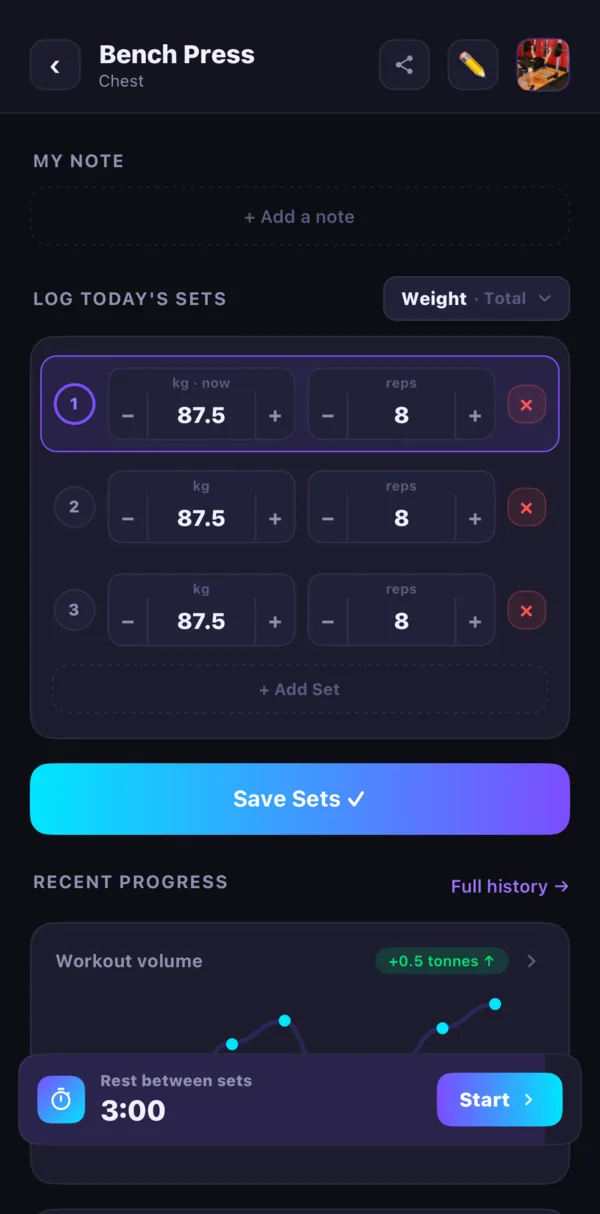
In Lifter Log, the Est. 1RM trend in Analytics → Strength & PRs uses weighted sets of 1 to 10 reps. For a lift you train above 10 reps, like the raise, follow the exercise's top-set weight and total-reps charts instead.
To turn a rep target into a starting weight, use the 1RM calculator or our 1RM percentage chart. Then let the log decide: the reps you got last time set the weight for this time, the core of tracking progressive overload.