How Many Exercises per Workout? Divide Your Weekly Sets
How many exercises per workout? Our rule: divide each muscle's weekly sets by its training days, then by about 3 sets per exercise, rounded, and add up the day's muscles. At 12 weekly sets for each of eight muscle groups, that's 8 exercises on three full-body days and 4 to 6 on six-day push pull legs.
On this page
- How many exercises per workout? Start from weekly sets
- Full body 8, push pull legs 4 to 6: same sets, four splits
- Trim a crowded day with half sets, a fourth day or supersets
- Pick exercises that train a muscle in different ways
- New lifters can start with fewer, mostly compound lifts
- Put the lift you most want stronger first
- Too many exercises shows up in your log first
- FAQ
How many exercises per workout? Start from weekly sets
A workout is a share of your week. So start from the week: how many hard sets each muscle gets, and on how many days. The exercise count follows from those two numbers.
Our rule: for each muscle you train that day, weekly sets ÷ sessions that train it ÷ 3 sets per exercise, rounded to whole exercises of 2 to 4 sets. Add up the day's muscles.
The two inputs in our examples:
- 12 weekly sets per muscle. It is the number our guide to sets per muscle group aims for. A 2022 review of trained young men suggested 12 to 20 may be an optimum, so it sits at the low end.
- 3 sets per exercise. That is our working number. In a 2019 trial, trained men did 3 sets of 6 exercises, four days a week, with 2 minutes' rest between sets.
Each exercise counts for the one muscle it mainly trains, as in our sets guide. That keeps the sums simple.
Here is a six-day push pull legs week worked through. Each muscle is trained twice, so it needs 12 ÷ 2 = 6 sets a session, which is 2 exercises of 3 sets:
- Push day, 6 exercises: chest 2, shoulders 2, triceps 2, for 18 sets.
- Pull day, 4 exercises: back 2, biceps 2, for 12 sets.
- Legs day, 6 exercises: quads 2, hamstrings 2, calves 2, for 18 sets.
Run these three days twice in the week and every muscle gets its 12 sets. Change either input and the count changes with it.
Full body 8, push pull legs 4 to 6: same sets, four splits
Take one week of training: 12 sets for each of eight muscle groups (chest, back, shoulders, biceps, triceps, quads, hamstrings and calves), 96 sets in all. Lay it out on four common splits and the sessions change shape:
| Split | Sets per muscle per session | Exercises per session | Minutes per session |
|---|---|---|---|
| Full body, 3 days (each muscle 3 times) | 4 | 8, one of 4 sets per muscle | 90 |
| Upper lower, 4 days (each muscle twice) | 6 | Upper 10, lower 6 | 85 and 55 |
| Push pull legs, 6 days (each muscle twice) | 6 | Push 6, pull 4, legs 6 | 55, 40 and 55 |
| Bro split, 5 days (each muscle once) | 12 | Chest, back and shoulders 4 each, arms 8, legs 12 | 40, 70 and 100 |
The minutes use the formula from our guide to how long a workout should be: a 10-minute warm-up plus each set × (half a minute + 2 minutes' rest). So 18 sets take 10 + 18 × 2.5 = 55 minutes.
Two minutes is the top of the 1 to 2 minutes the American College of Sports Medicine's position stand recommends for muscle growth in novice and intermediate lifters.
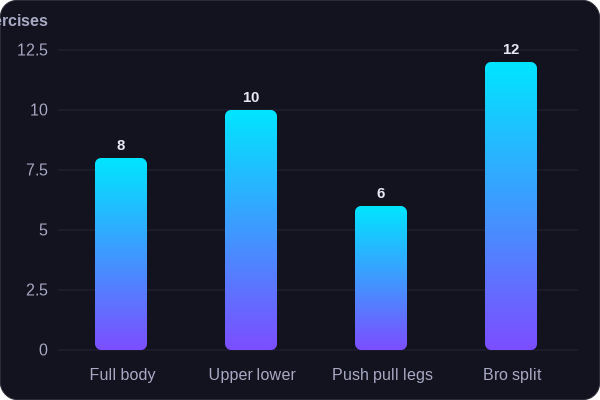
By our arithmetic, only the six-day push pull legs week keeps every session under an hour at 12 sets per muscle. The fewer days a muscle is trained, the more exercises each of its sessions needs. A bro split's leg day carries three muscles once a week, so by our rule it needs 12 exercises.
Common mistake: Counting exercises instead of sets. Six exercises of 2 sets and three of 4 are the same 12 sets for that muscle.
Trim a crowded day with half sets, a fourth day or supersets
A 10-exercise upper day and a 90-minute full-body day are what the sums give, not what you have to train. Three changes shorten them.
- Let presses and pulls count toward the arms. Our sets guide explains the half-set rule: a pressing set gives the triceps half a set, a rowing or pulldown set gives the biceps half. Keep one direct exercise for each arm muscle and the upper day drops from 10 exercises to 8. Under that rule, the arms still reach at least 12 weekly sets. Muscle balance in the app counts each exercise toward its own muscle group, so it would show them at 6.
- On full body, add a day. The count there is the number of muscles you train directly, 8 in our example. Spread the same 12 weekly sets over four days and each exercise gets 3 sets: 24 sets a session, 70 minutes by the formula.
- Superset or move a lift. Our workout length guide shows two supersets, then the arm superset moved to another day, cutting a 56.5-minute session to 40 with no weekly set lost.
Here is the trimmed upper day, 8 exercises of 3 sets:
| Muscle | Exercises | Sets per session, half-set rule |
|---|---|---|
| Chest | Bench press, incline dumbbell press | 6 |
| Back | Barbell row, lat pulldown | 6 |
| Shoulders | Overhead press, lateral raise | 6 |
| Biceps | Biceps curl | 3 + half of 6 pulling sets = 6 |
| Triceps | Triceps pushdown | 3 + half of 9 pressing sets = 7.5 |
That is 24 sets and 70 minutes by the formula, down from 85. Over two upper days, biceps get 12 sets a week and triceps 15 under the half-set rule, down from 18 and 21 on the 10-exercise day counted the same way. Counted this way, other muscles would gain sets too.
Pick exercises that train a muscle in different ways
Once a muscle gets two or more exercises, which ones matters. Three sources, all small or in young men, give the picture.
- Varied leg exercises reached more of the thigh. A 12-week study split 49 people into a control group and four groups that trained twice a week. The groups that varied their leg exercises grew all four heads of the quadriceps. The groups that kept one exercise showed no significant growth in one or two of the heads. Whole-quadriceps growth was similar in every training group.
- Planned change seems to help, constant change may not. A 2022 review of 8 studies, 241 young men in all, found some planned variation seems to help regional growth and strength. It warns that excessive, random rotation, or exercises that repeat the same stimulus, may hinder gains.
- Random picks each session kept up, and motivation rose. In the 2019 trial, an app picked one group's 6 exercises at random each session, and their rep ranges were randomized session by session too. 19 of 21 men finished the 8 weeks. Squat and bench press strength and thigh thickness rose similarly in both groups, though one thigh muscle grew significantly only in the fixed group. Intrinsic motivation rose only with the random picks (15 of the 19 answered that questionnaire).
So for two exercises per muscle, pick ones that load it differently, such as a squat and a leg extension for the quads. Keep them for several weeks, so your log can show whether they work.
To see whether a muscle is growing, not just lifting more, tape it every few weeks, as in how to track body measurements.
New lifters can start with fewer, mostly compound lifts
In your first months, the exercise count can be lower than any table above. Compound lifts train several muscles at once, and the extra isolation work may add little at first.
In a 2013 study, 29 untrained young men trained for 10 weeks. One group did lat pulldowns and bench presses only; the other added biceps curls and triceps extensions. Elbow flexor thickness rose 6.5% with the two compound lifts and 7.04% with the arm exercises added, with no significant difference between the groups. Peak torque did not differ either.
A 2021 review of time-efficient training says single-joint exercises seem unlikely to add substantial benefit for the general public, especially people with little training experience. It also calls their role equivocal, and for time-efficient training it recommends prioritizing multi-joint exercises.
Our guide to starting strength training uses 3 exercises per session, all compound: a squat or hinge, a press and a pull. Add isolation lifts once a muscle lags or the week's set count asks for them.
Put the lift you most want stronger first
A 2021 meta-analysis of 11 studies found strength gains were largest in the exercises done at the start of a session. For muscle growth, it found either order may give similar results.
For strength programs, the ACSM position stand recommends this order, to keep each exercise's intensity high:
- Large muscle groups before small ones. Squat before calf raise.
- Multi-joint exercises before single-joint ones. Bench press before triceps pushdown.
- Higher-intensity exercises before lower-intensity ones. Heavy sets of 5 before lighter sets of 12.
If one lift's strength is behind, you can break that order on purpose for a few weeks. Put it first while you are fresh, then check the log.
Too many exercises shows up in your log first
None of the sources here sets an upper limit on exercises. In a 2019 trial of trained men, every group did the same 7 exercises. Those doing 5 sets of each, about 68 minutes a session, grew more muscle at three of four sites than those doing 1 set. Strength rose similarly in all groups.
So the limit is yours to find, and your log finds it. Our working rule has three signs that a session holds one exercise too many:
- The last exercise loses reps while the first ones rise. Same weight, fewer reps, three sessions running. Move it earlier or to another day.
- The session runs past your time. Ten minutes over, week after week, means a lift moves or a pair becomes a superset.
- A muscle gets far more sets than the rest. Count the week. The models in a 2026 analysis of 67 studies suggest diminishing returns. If so, a fourth exercise for a muscle already at 12 sets likely adds less than one for a muscle that is short.
In Lifter Log, each exercise opens with last session's sets pre-filled, so a late lift losing reps is in front of you.
Muscle balance in the Analytics tab shows sets per muscle group for the period, plus the groups you haven't trained lately. It counts each exercise toward its own muscle group, as our first table does; the trimmed upper day uses the half-set rule instead.