How Many Days a Week Should You Lift Weights? Go by Level
How many days a week should you lift weights? The American College of Sports Medicine recommends 2 to 3 for beginners, 3 to 4 for intermediates and 4 to 6 for advanced lifters. In a 2019 meta-analysis, training a muscle more often made no meaningful difference to growth when weekly volume was equal, so choose days you can keep.
On this page
- How many days a week should you lift weights? By level
- Five gym days can train a muscle less often than three
- For strength, training a muscle more often may help
- A missed session costs a muscle a third to all of its week
- Pick the days you finish, then check after four weeks
- When to add a day, and when to drop one
- FAQ
How many days a week should you lift weights? By level
The American College of Sports Medicine (ACSM) ties the number of days to how long you have been training. Its 2009 position stand gives three levels:
| Your training | Days a week | How ACSM lays the days out |
|---|---|---|
| Novice: untrained, or no lifting for several years | 2–3 | The whole body in each workout |
| Intermediate: about 6 months of consistent training | 3–4 | 3 whole-body days, or 4 split days that train each major muscle group twice |
| Advanced: years of training | 4–6 (abstract: 4–5) | Often splits: not every muscle group in every workout |
The evidence gets thinner as the days go up. ACSM grades the novice advice A, its strongest category, the intermediate advice B and the advanced advice C. Its abstract gives advanced lifters 4 to 5 days, while its strength and muscle-growth sections and its summary table say 4 to 6.
For health, the World Health Organization's 2020 guidelines set a floor: muscle-strengthening activity at moderate or greater intensity, working all major muscle groups, on 2 or more days a week.
So if you are new, start with 2 or 3 whole-body days. Our guide to how to start strength training has a three-day plan to copy.
Five gym days can train a muscle less often than three
The frequency analyses on this page count how often each muscle group is trained, which is not the same as how often you go to the gym. On a split, the two numbers part ways:
| Days a week | Split | Sessions that train each muscle directly |
|---|---|---|
| 2 | Full body | 2 |
| 3 | Full body | 3 |
| 3 | Push pull legs, each once | 1 |
| 4 | Upper lower | 2 |
| 5 | Bro split | 1 |
| 6 | Push pull legs, each twice | 2 |
Five days on a bro split train each muscle directly once a week. Three full-body days train it three times.
For muscle growth, the sets you do may count for more than the days you spread them over. A 2019 meta-analysis of 25 studies found no significant difference in growth between higher and lower frequencies when weekly volume was equal. Its authors conclude that, for a given volume, you can choose how often to train each muscle by personal preference.
Where volume was not equal, higher frequencies came out ahead. The difference between training a muscle once and three or more times a week was modest.
Our reading: extra days help growth when they add sets. Our guide to sets per muscle group per week covers that count. Fewer days with the same sets make each session longer, and how long a workout should be works out the minutes.
For strength, training a muscle more often may help
For strength, the picture is less settled. Here are two large analyses, eight years apart:
| Analysis | What it covered | What it found |
|---|---|---|
| Grgic et al., 2018 | 22 studies, mostly in untrained people | Gains grew with frequency (effect sizes 0.74, 0.82, 0.93 and 1.08 at 1, 2, 3 and 4 or more sessions a week), but not significantly in volume-equated studies. |
| Pelland et al., 2026 | 67 studies, 2,058 people, 79% male, average age about 25 | Its models, which allowed for weekly sets, suggest strength gains rise with how often a muscle is trained, with diminishing returns. The effect on muscle growth was compatible with a negligible one. |
The 2018 authors say the effects seem to be driven mostly by volume: more sessions are a way to fit in more sets. They add that it remains unclear whether frequency on its own changes strength gains.
The 2018 subgroups pooled studies with and without equal volume. In them, higher frequencies came out significantly ahead on multi-joint lifts and upper-body strength, but not on single-joint lifts or lower-body strength.
The 2026 analysis allowed for weekly sets and suggests extra sessions, not only extra sets, may help strength.
Our working rule: if one lift's strength is the goal, train it on two days rather than one, and count its sets across the week. The 2018 gains were clearest on multi-joint and upper-body lifts such as the bench press, though extra sets may explain them. Check the lift every few weeks, as in how often to test your 1RM.
A missed session costs a muscle a third to all of its week
Every plan meets a bad week. How much a missed session costs depends on how many sessions train each muscle.
Here is our worked example. Each muscle gets 12 direct sets a week, the number our sets guide suggests aiming near. The sets are split evenly across the sessions that train that muscle, and each exercise counts toward one muscle. Miss one session and its muscles keep the rest of their week:
| Schedule | Sessions per muscle | Sets per muscle per session | Direct sets left for the missed session's muscles |
|---|---|---|---|
| Full body, 2 days | 2 | 6 | 6 of 12 |
| Full body, 3 days | 3 | 4 | 8 of 12 |
| Upper lower, 4 days | 2 | 6 | 6 of 12 |
| Push pull legs, 6 days | 2 | 6 | 6 of 12 |
| Push pull legs, 3 days | 1 | 12 | 0 of 12 |
| Bro split, 5 days | 1 | 12 | 0 of 12 |
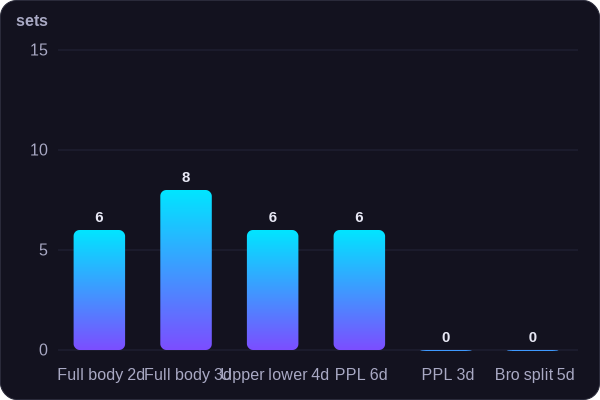
Three full-body days keep the most for the muscles you missed: 8 of 12 sets, and every muscle is still trained twice that week.
On the two once-a-week schedules, the missed day's muscles get no direct sets until the next week. On the bro split, presses and rows on the other days still work the arms indirectly, so for an arm day the zero counts direct sets only.
On a split, a miss costs only the muscles of that day. On a full-body plan, every muscle loses a share: 4 of its 12 sets on three days, 6 on two.
Common mistake: Missing the same weekday every week. If legs fall on Friday and Friday keeps slipping, your legs lose out every week. Run the workouts as a rotation instead: on each day you train, do the next one in line, so a miss delays a session rather than dropping the same one.
In Lifter Log you can schedule a workout after another workout, as an A/B rotation, instead of on fixed weekdays.
Pick the days you finish, then check after four weeks
The right number is the one you keep. Here is how to choose it and check it:
- Start from your level's range in the first table.
- Count the days a normal week allows, not your best week. Our working rule: plan the number of days you trained in at least three of the last four weeks.
- Pick the split for that number from the second table. If misses are likely, choose one that trains each muscle at least twice, so a miss costs part of a week, not all of it.
- Fix the days in advance. A meta-analysis of 26 studies found that if-then plans, deciding when and where you will act, gave physical activity a small-to-medium boost. It measured activity in general, not lifting.
- Compare planned with done after four weeks. Our working rule: if you finished fewer days than planned in two of the four weeks, drop a day. If you finished every one and your weekly sets no longer fit, add a day.
If you are new, showing up is the habit you are building.
In a survey study of 111 new gym members, exercising at least four times a week for six weeks was the minimum the authors found to establish an exercise habit. That counted exercise of any kind, as the members reported it, so your lifting days and any other exercise sessions both count toward it.
In a 12-week study of new daily habits, missing a single day did not materially affect how the habit formed. It tracked simple daily habits such as eating, drinking or activity, not lifting sessions.
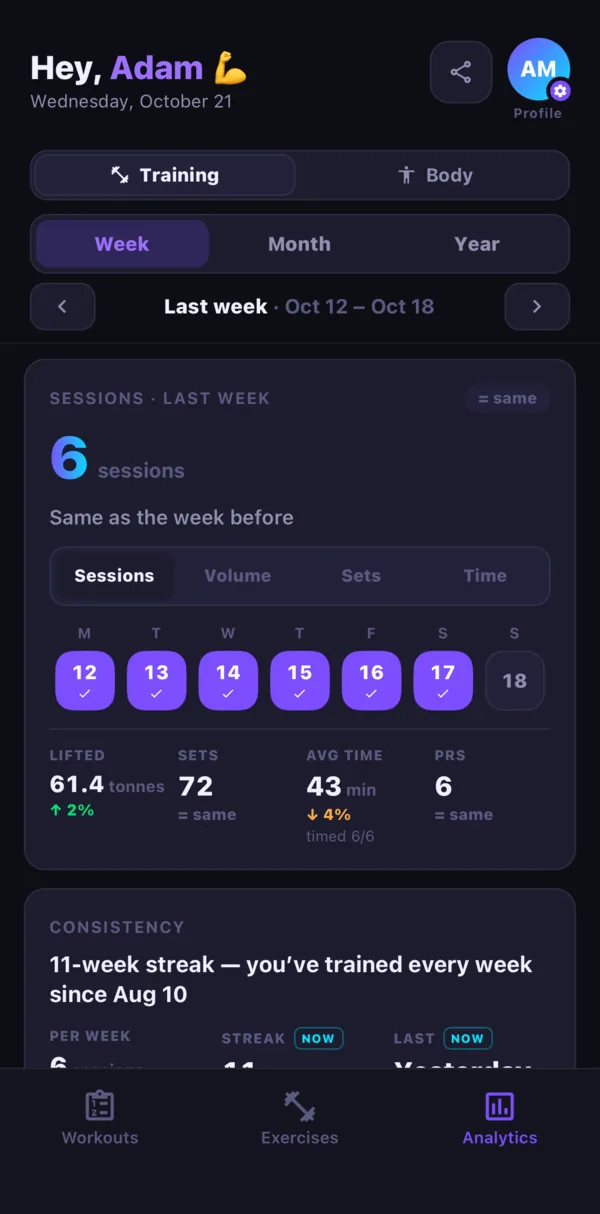
In Lifter Log, the Analytics tab keeps this count. Consistency shows your sessions per week, your streak and a calendar. Workouts shows planned against done. Muscle balance lists the muscle groups you haven't trained lately, which is where a missed day shows up. Some sections appear after a few logged sessions.
When to add a day, and when to drop one
Change the number after a four-week check, one day at a time. These are our working rules:
- Add a day when you finished every planned session for four weeks and your weekly sets no longer fit, so sessions run long. A fourth day lets a 3-day full-body plan become a 4-day upper lower split.
- Give a lift a second day when its strength is your goal and it gets one session a week.
- Drop a day after two short weeks in four. A short week is one with fewer sessions than planned. Pick a split that trains each muscle at least twice, so a miss costs those muscles half their week or less, not all of it.
- Move up a level after about six months of consistent training. ACSM's intermediate range is 3 to 4 days.