How to Make a Workout Plan: 6 Steps and a Time Check
How to make a workout plan: pick the days you'll finish and, by our rule, a split training each muscle at least twice. Our formula: a set with 2 minutes' rest takes 2.5 minutes, so an hour holds 20 sets after a 10-minute warm-up. Our default: about 3 sets of 6–12 reps on big lifts, adding weight by rule.
On this page
How to make a workout plan: six decisions, in order
A plan is six decisions, and each one limits the next, so make them in this order. The sections below cover each step and link the guide that goes deeper.
- Days: the number you trained in at least three of the last four weeks. That is our working rule from how many days a week to lift.
- Split: by our rule, one that trains each muscle at least twice on those days, so a missed session costs only part of a muscle's week.
- Minutes: the time a normal session can take. It caps your sets, as the formula below shows.
- Weekly sets per muscle: aim near 12 when the minutes allow, as our guide to sets per muscle group does.
- Exercises: our defaults are big lifts first, about 3 sets each, 6–12 reps on big lifts and 10–20 on small ones.
- Progress: a rule for adding weight, and a check of the log every four weeks.
New to lifting? Skip the build for now. The American College of Sports Medicine (ACSM) recommends 2 to 3 whole-body days a week for novices, and our starter plan is three of them. Our suggestion: build your own after about 6 months of consistent training, where ACSM's intermediate level starts.
Plan the days you finish and a split that fits them
Count the days a normal week allows, not your best week. Then check that number against your level. ACSM's 2009 position stand recommends 2 to 3 days a week for novices and 3 to 4 for intermediates. For advanced lifters, its body text says 4 to 6 and its abstract 4 to 5.
Then pick the split. The days you go and the times each muscle is trained are different numbers:
| Days a week | Split | Sessions that train each muscle |
|---|---|---|
| 2 | Full body | 2 |
| 3 | Full body | 2 or 3 |
| 3 | Push pull legs, each once | 1 |
| 4 | Upper lower | 2 |
| 5 | Bro split | 1 |
| 6 | Push pull legs, each twice | 2 |
For muscle growth, how you spread the sets may matter little. A 2019 meta-analysis of 25 studies found no significant difference between higher and lower frequencies when weekly volume was equal. For strength, training a muscle more often may help, as our days guide explains.
So our rule is about missed days. On a 3-day full-body plan, miss one day and a muscle trained three times is still trained twice. One trained twice, like the hamstrings in our example below, keeps one session. Miss the leg day of a bro split and your legs get no direct sets until the next week.
Write the days down before the week starts. A meta-analysis of 26 studies found that if-then plans, deciding when and where you will act, gave physical activity a small-to-medium boost. It measured activity in general, not lifting. Our guide to staying consistent covers the rest.
Your minutes decide how many sets fit
The top guides we read skip this step. Every working set costs about half a minute of lifting plus the rest after it. We use the formula from how long a workout should be, with 2 minutes' rest after every set:
Our formula: session minutes = a 10-minute warm-up + working sets × 2.5. Turned around, the sets that fit = (minutes minus 10) ÷ 2.5. An hour holds 20. Half a minute covers about 10 reps at 3 seconds a rep.
Two minutes is the top of the 1 to 2 minutes ACSM recommends for muscle growth in novice and intermediate lifters. The 10 minutes are our working number for a few lighter sets first; how many warm-up sets covers those.
Here is what the formula gives over a week. The weekly sets are shared evenly across 8 muscle groups (chest, back, shoulders, biceps, triceps, quads, hamstrings and calves). Each exercise counts for one muscle, and the share is rounded down:
| Session (sets that fit) | 2 days: sets a week (per muscle) | 3 days | 4 days |
|---|---|---|---|
| 45 minutes (14) | 28 (3) | 42 (5) | 56 (7) |
| 60 minutes (20) | 40 (5) | 60 (7) | 80 (10) |
| 75 minutes (26) | 52 (6) | 78 (9) | 104 (13) |
| 90 minutes (32) | 64 (8) | 96 (12) | 128 (16) |
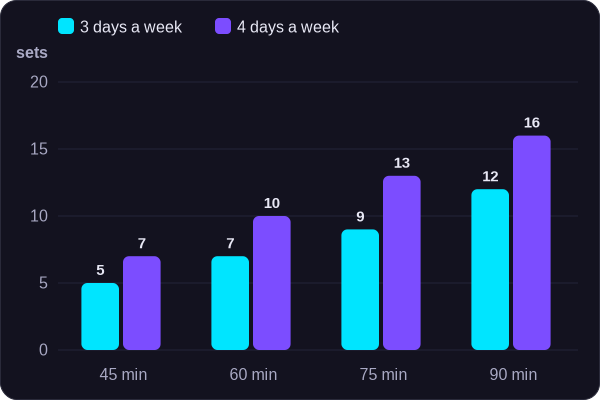
Read across to find your week. Twelve sets for all eight muscle groups takes 96 sets: three 90-minute sessions, or four of 70 minutes with 24 sets each. Three one-hour sessions hold 60 sets: an even 7 per muscle group, with 4 left over.
Fewer sets is a trade you can make on purpose. In a 2017 meta-analysis of 15 studies, each added weekly set was linked to about 0.37% more muscle growth. So fewer sets likely means slower growth, and the table shows what more sets cost in time.
Common mistake: Writing a plan from a list of favorite exercises, then finding each session runs 90 minutes. Do the sum first, then pick the exercises.
Fill each session: big lifts first, about 3 sets each
With the set budget known, share it out. Give the big muscles their sets first, then the small ones. Four rules, ours and ACSM's, decide what goes where:
- About 3 sets per exercise. It is our working number, from our guide to how many exercises per workout. Round each muscle's share for the day to exercises of 2 to 4 sets.
- Big lifts first. For strength programs, ACSM recommends large muscle groups before small ones, and multi-joint lifts before single-joint ones. A 2021 meta-analysis of 11 studies found strength gains were largest in the exercises done at the start of a session. For growth, either order may give similar results.
- A different exercise for a muscle on each of its days. That is our working rule, with the same exercises every week. A 2022 review of 8 studies in young men found some planned variation seems to help regional muscle growth and strength. It warns that excessive, random rotation, or exercises that repeat the same stimulus, may hold gains back. Treat our pattern as a working rule and let your log judge it.
- 6–12 reps on big lifts, 10–20 on small ones. That is our default from how many reps to build muscle, with most sets stopped 1 to 3 reps short of failure.
Rest is the number most likely to break the sum. For strength, ACSM advises at least 2 to 3 minutes on core lifts with heavier loads, such as the squat and bench press. Rest 3 minutes instead of 2 and each of that lift's sets adds a minute to the session.
A 3-day, 60-minute plan, built and counted
Here are the six steps run for one example lifter, who wants muscle growth and has about 8 months of training. They trained three days in at least three of the last four weeks, an hour each time. The numbers are an example, not data from a study.
Three days sits inside ACSM's 3 to 4 for intermediates. Full body puts chest, back, quads and arms in every session, and the other three groups in two of the three. Miss a day and every muscle still keeps at least one session that week.
An hour gives up to 20 sets a session. The plan uses 19, so 57 a week: 9 each for chest, back and quads, and 6 for each of the other five groups.
| Muscle | Day A, Monday | Day B, Wednesday | Day C, Friday |
|---|---|---|---|
| Quads | Back squat 3 × 6–8 | Leg press 3 × 8–12 | Split squat 3 × 8–12 |
| Chest | Bench press 3 × 6–8 | Incline dumbbell press 3 × 8–12 | Machine chest press 3 × 8–12 |
| Back | Barbell row 3 × 8–12 | Lat pulldown 3 × 8–12 | Seated cable row 3 × 8–12 |
| Hamstrings | Romanian deadlift 3 × 8–12 | none | Leg curl 3 × 10–20 |
| Shoulders | Lateral raise 3 × 10–20 | Overhead press 3 × 6–8 | none |
| Calves | none | Standing calf raise 3 × 10–20 | Seated calf raise 3 × 10–20 |
| Biceps | Biceps curl 2 × 10–20 | Hammer curl 2 × 10–20 | Incline dumbbell curl 2 × 10–20 |
| Triceps | Triceps pushdown 2 × 10–20 | Overhead triceps extension 2 × 10–20 | Skull crusher 2 × 10–20 |
| Sets, and minutes by our formula | 19 sets, 57.5 minutes | 19 sets, 57.5 minutes | 19 sets, 57.5 minutes |
Do each day from top to bottom, so the multi-joint lifts come first. By the formula, each day takes 10 + 19 × 2.5 = 57.5 minutes. With 3 minutes' rest on day A's squat and bench press, that day grows by 6 minutes, to 63.5.
Sets of 20 reps also run long: a full minute at 3 seconds a rep. At 20 reps, day C's ten small-lift sets add 5 minutes, to 62.5.
Now count the week. Our sets guide gives each exercise to one muscle, or lets presses give the triceps half a set and rows and pulldowns give the biceps half. Here is the plan both ways:
| Muscle | Sets a week, one muscle per exercise | Half-set rule, arms only |
|---|---|---|
| Chest, back, quads | 9 each | 9 each |
| Shoulders, hamstrings, calves | 6 each | 6 each |
| Biceps | 6 | 10.5 (6 + half of 9 rowing and pulldown sets) |
| Triceps | 6 | 12 (6 + half of 12 pressing sets) |
The arms get 2 direct sets a session because the presses and pulls already work them. Counted that way for every muscle, others would gain sets too.
Every muscle lands at 6 to 9 direct sets, under the 12 our sets guide aims for. That is what three one-hour sessions hold. When a muscle stalls, the review below adds sets to it, at 2.5 minutes each.
Add weight by a rule and review after four weeks
A plan without a progression rule repeats the same week. Ours, from the reps guide: add weight when every set reaches the top of its rep range. On the squat at 3 × 6–8 with 100 kg (220 lb), that means 8, 8, 8, then 102.5 kg (226 lb) next time.
ACSM suggests adding 2–10% to the load once you beat your target by one or two reps on two sessions in a row, with the lower end for small-muscle exercises. Our double progression guide works this out lift by lift.
Then run the plan for four weeks and check three things in your log. These are our working rules:
- Planned against done. If you finished fewer days than planned in two of the four weeks, drop a day and rebuild from the split step.
- A lift that stalled. Three sessions in a row with no new best weight, rep or total reps is a stall, as our plateau guide explains. Each lift here runs once a week, so that is three weeks. Add one or two sets to that muscle, and find their minutes in the formula.
- Session length. Ten minutes over, week after week, means a lift moves to another day or two lighter lifts become a superset.
Change one thing at a time, so the log can tell you what worked. Keep the exercises for several weeks too, so each week compares like with like.
In Lifter Log, the Analytics tab holds two of these checks, and each exercise's charts of top-set weight and total reps show whether a lift is still moving.
Workouts shows planned against done and your average session time. Muscle balance shows your sets per muscle group, counting each exercise toward its own muscle group as our first count does. Some sections appear after a few logged sessions.