How Many Sets per Muscle Group per Week? What Studies Say
For muscle growth, more hard weekly sets per muscle tend to mean more growth. A 2022 review of trained young men said 12 to 20 sets may be an optimum standard recommendation. The sample week below sits under that, at 6 to 8. Our rule: count your week, aim for 12, add sets where a muscle stalls.
On this page
How many sets per muscle group per week? Three reviews
No study gives one number that fits everybody. Three reviews come closest, and each answers a slightly different question.
| Review | What it covered | What it found |
|---|---|---|
| Schoenfeld et al., 2017 | 15 studies, weekly sets per muscle | Each added set was linked to about 0.37% more muscle growth. Higher against lower volume differed by 3.9%. |
| Baz-Valle et al., 2022 | 7 trials (6 pooled) of men aged 18 to 35 with at least a year of training | 12 to 20 weekly sets per muscle "may be an optimum standard recommendation". No difference was found between 12 to 20 and above 20 sets for quads or biceps. Higher volume appeared better for the triceps. |
| Pelland et al., 2026 | 67 studies, 2,058 people | More weekly sets meant more muscle and strength, with diminishing returns suggested by its best-fit models, more pronounced for strength. |
Read together, they point to more sets helping. The 2026 meta-regression is the one that reports diminishing returns, and its best-fit models "suggest" them. None of the three says where your own limit sits.
Common mistake: Treating 12 to 20 as a rule. It comes from a review of young, trained men, and its authors hedged it. In the 2017 analysis, the split into under 5, 5 to 9 and 10-plus sets showed only a trend (p = 0.074).
What counts as a set in the weekly total
A set counts when it is a working set taken near failure. A 2021 systematic review of trained adults found that sets to failure, or near it, seem an adequate volume measure for 6 to 20-plus reps, if other variables stay constant. Two rules keep your count honest.
- Leave out warm-ups. A set with an empty bar prepares you for the work and is not the work you are trying to progress.
- Pick a rule for compound lifts. A bench press trains the chest, and the triceps help. Count it for the chest only, or give the triceps half a set. Either works if you keep the same rule every week.
The 2026 meta-regression tested several counting rules and found the strongest support for the half-set rule on indirect sets. That is a statistical result, not a requirement for your log.
Count a sample week: 53 sets across eight muscles
Here is one sample week for an upper/lower split on four days. Only working sets are counted, and each exercise goes to one muscle.
| Day | Exercise (sets) | Muscle |
|---|---|---|
| Upper A | Bench press (4), barbell row (4), overhead press (3), barbell curl (3), triceps pushdown (3) | Chest 4, back 4, shoulders 3, biceps 3, triceps 3 |
| Lower A | Squat (4), Romanian deadlift (3), calf raise (3) | Quads 4, hamstrings 3, calves 3 |
| Upper B | Incline dumbbell press (3), lat pulldown (4), lateral raise (3), hammer curl (3), overhead triceps extension (3) | Chest 3, back 4, shoulders 3, biceps 3, triceps 3 |
| Lower B | Leg press (4), leg curl (3), calf raise (3) | Quads 4, hamstrings 3, calves 3 |
Add each muscle across the four days: chest 4 + 3 = 7, back 4 + 4 = 8 and quads 4 + 4 = 8. Shoulders, biceps, triceps, hamstrings and calves are 3 + 3 = 6 each. The four sessions have 17, 10, 16 and 10 sets, 53 in all.
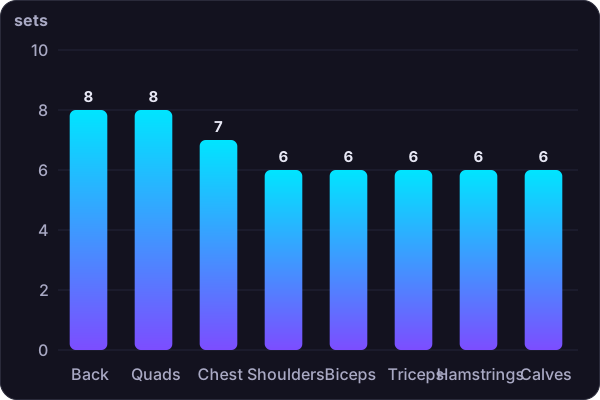
Under the one-muscle rule, every muscle sits at 6 to 8 sets, below the 12 to 20 range from the 2022 review.
Now count it the half-set way. The table shows two muscles where it makes a clear difference. Counting every muscle this way would move others too. The bench, incline and overhead presses add 10 sets, which gives the triceps 5 more. The rows and pulldowns add 8 sets, which gives the biceps 4 more.
| Muscle | One-muscle rule | Half-set rule |
|---|---|---|
| Triceps | 6 | 11 (6 + 5) |
| Biceps | 6 | 10 (6 + 4) |
The same week lands in a different place depending on the rule. Studies count in different ways too, so a range from one review will never match a hand count exactly. Use the range as a rough marker, and compare your own weeks with each other.
In Lifter Log, Muscle balance in the Analytics tab shows your sets per muscle group for the period, plus the groups you haven't trained lately. It counts each exercise toward its own muscle group, as the sample week's table does. It has no recommended-volume targets, so the range stays yours to choose.
Aim near 12, then add sets where a muscle stalls
The studies describe groups of lifters. Your log tells you about one lifter. This rule of thumb is ours, not a finding from the papers.
- Log a few normal weeks first. Write down working sets and the weight and reps for each, as in the workout logging guide.
- Total each muscle for the week. Use the volume guide's method and keep one counting rule.
- Look for the muscle that stalled. Three sessions with no new weight or rep is the sign. The plateau guide covers how to confirm it.
- Add one or two sets to that muscle. Change one muscle at a time, so the log can tell you what worked.
- Re-check after a few weeks. If the weights and reps move again, leave it. If not, look at rest, sleep and food before adding more.
If returns do diminish, as the 2026 models suggest, the last sets are the least efficient. Adding them everywhere costs recovery and time. Adding them where progress is stuck costs less.
Spread the sets across the week
A 2019 meta-analysis of 25 studies found similar muscle growth across training frequencies when weekly volume was equal. Its authors wrote that people can choose a frequency based on personal preference.
That gives you room. Twelve chest sets can be one session of 12 or two of 6. Pick the layout that lets you keep the quality of every set, which is easier at 6 per session. A push pull legs split shows how the same sets look at three and at six days.
Coach's tip: If a muscle is far behind the rest, put its sets early in the session while you are fresh. Do it for a few weeks, then check the count again.
For strength, frequency may matter too
Everything above is about muscle size. The 2026 meta-regression found strength gains also rose with weekly sets, with diminishing returns that were more pronounced than for size. It also suggested strength gains rise with training frequency, while the effect of frequency on size was compatible with negligible.
So if your goal is a heavier squat, the number of times you practise the lift may matter beside the set count. Use a 1RM calculator to check your estimated max every few weeks.