Bro Split Workout: 5-Day Plan and What 5 Studies Found
A bro split gives each body part its own day, often five a week: chest, back, legs, shoulders and arms. When weekly volume was equal, a 2024 meta-analysis of 14 studies found similar strength and muscle gains from split and full-body routines. So count your sets: in the sample plan below, chest gets 14 a week and hamstrings 6.
On this page
- A bro split gives each body part its own day each week
- Does a bro split work? Equal volume, mostly similar gains
- A 5-day bro split workout plan to copy
- Count the sets: this plan shorts the leg muscles
- How to track progress on a bro split
- Bro split vs push pull legs and upper lower: how to choose
- FAQ
A bro split gives each body part its own day each week
A bro split, also called a body-part split, trains one body part per session, such as chest or legs. Each body part gets its own day, and the classic week runs Monday to Friday:
| Day | Session | Muscle groups |
|---|---|---|
| Monday | Chest | Chest |
| Tuesday | Back | Back |
| Wednesday | Legs | Quads, hamstrings, calves |
| Thursday | Shoulders | Shoulders |
| Friday | Arms | Biceps, triceps |
| Saturday and Sunday | Rest |
The American College of Sports Medicine's 2009 position stand calls this kind of plan a muscle group split routine, with one to three muscle groups trained per workout.
For advanced lifters training for muscle growth, it notes these splits are common and allow more volume per muscle group, and it recommends 4–6 training days a week. It grades that advice C, based on non-randomized trials and observational studies.
For novices, the same stand recommends training the whole body 2–3 days a week. If you are new, start with a three-day full-body plan.
Does a bro split work? Equal volume, mostly similar gains
The usual complaint is that a bro split trains each muscle only once a week. These five studies speak to it, and whether weekly volume was equal changes the answer.
| Study | What it compared | What it found |
|---|---|---|
| Schoenfeld 2015, 20 trained men | Each muscle trained 1 day a week on a split vs 3 days on a total-body routine | Forearm flexor thickness grew more with total-body, one of three muscle sites measured. 1RM strength did not differ significantly. The authors suggest a potential growth benefit to higher frequency. |
| Brigatto 2019, 20 trained men, 8 weeks | 16 sets per muscle once a week vs 8 sets twice a week | No significant difference in strength or muscle thickness. Effect sizes favoured twice a week on some measures. |
| Schoenfeld 2019, 25 studies | Training frequencies, for muscle growth | Similar growth across frequencies when weekly volume was equal. Where it was not, higher frequencies did modestly better. |
| Ramos-Campo 2024, 14 studies, 392 people | Split vs full-body routines | Similar strength and muscle growth when volume was equated. |
| Pelland 2026, 67 studies | Weekly volume and frequency | Suggests strength gains rise with frequency, with diminishing returns. Frequency's effect on growth was compatible with a negligible one. Its authors declare that they coach and write in the fitness industry. |
Of the trials here, Brigatto's is the closest test of a bro split's long sessions: one weekly session of 16 sets for a muscle against two of 8. Both trials were small, with 20 men each, so read them next to the meta-analyses.
For muscle growth, then, the weekly sets look more important than the single day. For strength, the 2026 meta-regression suggests training more often helps, with diminishing returns.
Our reading: if a bigger bench or squat is your main goal, training those lifts twice a week may suit you better.
Common mistake: Treating "twice a week beats once" as settled. A 2016 meta-analysis concluded that from 10 studies. The 2019 analysis, with 25 studies, found similar growth across frequencies once weekly volume was equal.
A 5-day bro split workout plan to copy
Here is a sample plan. Big lifts come first and single-joint lifts last, one of the exercise orders ACSM's position stand recommends for muscle group splits. Reps are ranges, so you can add weight by double progression. Warm-up sets are not counted.
| Day | Exercises (sets × reps) | Sets |
|---|---|---|
| Chest | Bench press 4 × 6–8, incline dumbbell press 4 × 8–10, machine chest press 3 × 10–12, cable fly 3 × 12–15 | 14 |
| Back | Pull-up 4 × 6–10, barbell row 4 × 6–8, lat pulldown 3 × 10–12, seated cable row 3 × 10–12 | 14 |
| Legs | Back squat 4 × 5–7, Romanian deadlift 3 × 8–10, leg press 3 × 10–12, lying leg curl 3 × 10–12, standing calf raise 3 × 10–15 | 16 |
| Shoulders | Seated dumbbell shoulder press 4 × 8–10, lateral raise 4 × 12–15, rear delt fly 3 × 12–15 | 11 |
| Arms | Close-grip bench press 4 × 6–8, barbell curl 4 × 8–10, incline dumbbell curl 3 × 10–12, triceps pushdown 3 × 12–15 | 14 |
That is 69 working sets a week. The day totals look even, from 11 to 16 sets. The muscle totals are not, as the next section shows.
Count the sets: this plan shorts the leg muscles
Give each exercise to one muscle and add up the week:
- Chest 14 and back 14: four lifts each, on their own day.
- Shoulders 11: press, lateral raise and rear delt fly.
- Quads, biceps and triceps 7 each: two lifts each.
- Hamstrings 6 and calves 3: they share leg day with the quads. Squats and Romanian deadlifts train the glutes too, but here they count only toward quads and hamstrings.
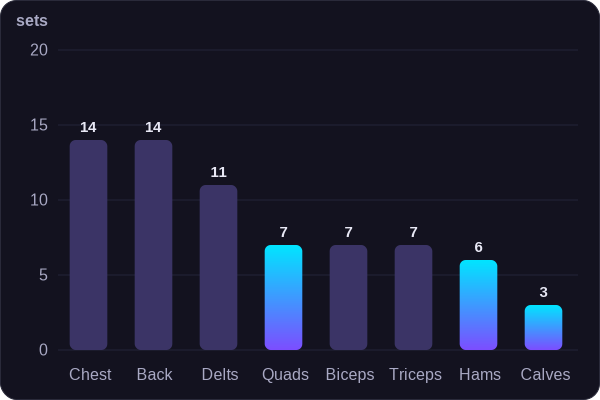
Leg day carries three muscle groups in one session, so each gets less than chest or back. On this plan, quads get half of chest's sets and calves fewer than a quarter.
Your arms train on more than one day
Presses also work the triceps, and pulls work the biceps. The 2026 meta-regression counted that kind of indirect set as half a set. We worked out the arms with that rule and our own choice of lifts, presses for triceps and pulls for biceps:
- Triceps 14.5: 7 direct sets, plus half of 15 pressing sets (11 on chest day, 4 shoulder presses).
- Biceps 14: 7 direct sets, plus half of the 14 pulling sets on back day.
So for the arms, one day a week holds only on paper. In this plan, the triceps work on Monday, Thursday and Friday, and the biceps on Tuesday and Friday. As written, the plan trains the leg muscles on Wednesday alone.
The fix for legs, by our working rule: add the missing sets to an existing day before you add a sixth. Put lying leg curl 3 × 10–12 and seated calf raise 3 × 12–15 on arm day.
Hamstrings go from 6 to 9 sets and calves from 3 to 6, both now on two days. Quads stay at 7, on Wednesday alone. Friday grows from 14 to 20 sets, and Thursday in between keeps the leg days apart.
Whether 9 sets is enough has its own guide: how many sets per muscle group per week. A 2017 meta-analysis of 15 studies linked more weekly sets per muscle to more growth, and it did not define an upper limit.
How to track progress on a bro split
On the plan as written, each lift comes round once a week, so your log compares this Monday with last Monday. Five habits keep that comparison honest:
- Log every working set. Weight and reps, as in how to log workouts. Seven days is a long time to remember a rep count.
- Add weight at the top of the range. Bench press 4 × 6–8 at 80 kg (176 lb): once all four sets reach 8, add 2.5 kg (5.5 lb), which is 3.1% of 80 kg. That trigger is our working rule. ACSM recommends adding 2–10% once you beat your target by one or two reps on two sessions in a row, the lower end for small-muscle lifts. On a bro split, two sessions take two weeks.
- Judge a stall in weeks. On this split, three bench sessions take three weeks. Our working rule: if a lift hasn't moved in three sessions, change one thing on that lift, not the whole split. The plateau guide covers how to confirm a stall.
- Check sets per muscle once a month. In Lifter Log, Muscle balance in the Analytics tab shows sets per muscle group for the period, plus the groups you haven't trained lately. It counts sets by each exercise's muscle group, so it shows the direct count above, not the half-sets. Its totals match this page only if your exercises are tagged the same way.
- Measure size every few weeks. Tape your upper arms and thighs, as in how to track body measurements. Lifts can rise faster than muscles grow, as how to track muscle growth explains.
Bro split vs push pull legs and upper lower: how to choose
The splits differ mainly in how many sessions a week train each muscle group directly:
| Split | Days a week | Direct sessions per muscle group a week |
|---|---|---|
| Bro split | 4–5 | 1 on the plan as written, with indirect arm work on more days |
| Push pull legs | 3 to 6 | 1 to 2 |
| Upper lower | 4 | 2 |
| Full body | 2–3 | 2–3 |
With weekly volume equal, the 2024 meta-analysis found split and full-body routines similar for strength and growth. So choose on three things:
- Your experience. ACSM's novice advice is 2–3 whole-body days a week, and it lists muscle group splits as common in advanced training.
- Your goal. For strength on a few lifts, the 2026 frequency finding points to training them more than once a week. That is our reading, not a trial result.
- Your week. On the plan as written, a missed day means that body part gets no direct sets that week. It suits a schedule that rarely moves.
Whichever you pick, keep it for several weeks and let your log decide. Change one lift at a time, and compare each session with the same session a week earlier.