Push Pull Legs Split: Weekly Schedule for 3 to 6 Days
A push pull legs split trains pushing muscles, pulling muscles and legs on separate days. Run it three days a week and each muscle gets one session; run it six days and each gets two. On the sample plan below, that is 6 chest sets a week at three days and 12 at six.
On this page
A push pull legs split has three kinds of session
Each session groups the muscles that work together. Push trains chest, shoulders and triceps. Pull trains back and biceps. Legs trains quads, hamstrings and calves.
Here is one plan to count with. Every exercise is 3 working sets, so the numbers are easy to check. Warm-up sets are left out.
| Session | Exercises (3 sets each) | Sets by muscle | Total |
|---|---|---|---|
| Push | Bench press, incline dumbbell press, overhead press, lateral raise, triceps pushdown | Chest 6, shoulders 6, triceps 3 | 15 sets |
| Pull | Barbell row, lat pulldown, seated cable row, biceps curl | Back 9, biceps 3 | 12 sets |
| Legs | Squat, leg press, Romanian deadlift, calf raise | Quads 6, hamstrings 3, calves 3 | 12 sets |
The week is one Push, one Pull and one Legs session: 39 sets. Every other version of the split repeats these three sessions more often, which is the only thing that changes.
Push pull legs split: how many days a week?
The days you train set how often each session comes round. With three or six days the weeks repeat. With four or five, the sessions keep rotating, so a muscle's gap varies from week to week.
| Days a week | How it runs | Each muscle per week | Chest sets | Back sets | All sets |
|---|---|---|---|---|---|
| 3 | Push, Pull, Legs, for example Mon, Wed, Fri | 1× | 6 | 9 | 39 |
| 4 | Rolling: 12 sessions in 3 weeks, 4 of each | 1.33× on average | 8 | 12 | 52 |
| 5 | Rolling: 15 sessions in 3 weeks, 5 of each | 1.67× on average | 10 | 15 | 65 |
| 6 | Push, Pull, Legs, Push, Pull, Legs, 1 day off | 2× | 12 | 18 | 78 |
The arithmetic is sessions per week times sets per session. A 5-day week averages 5 ÷ 3 = 1.67 sessions of each type, so chest gets 6 × 1.67 = 10 sets. A 3-day split trains each muscle once a week, not twice.
Which to pick: three days if time is tight and you will make the sessions longer; six days if you can keep up both the attendance and the volume; four or five if your week moves around. If you have never lifted, a three-day full-body start is simpler than any split.
Common mistake: Comparing splits by days alone. Going from three to six days doubles the weekly sets only if the sessions stay the same length. Six sessions of 6 sets each give 36 sets, fewer than the 45 in three sessions of 15.
A 5-day split rotates across three weeks
With five sessions in a row and three session types, the weekdays never line up. Push lands on Monday and Thursday in week one, Tuesday and Friday in week two, and Wednesday in week three. Here is the full cycle, training Monday to Friday and resting at the weekend.
| Mon | Tue | Wed | Thu | Fri | |
|---|---|---|---|---|---|
| Week 1 | Push | Pull | Legs | Push | Pull |
| Week 2 | Legs | Push | Pull | Legs | Push |
| Week 3 | Pull | Legs | Push | Pull | Legs |
Count the cycle: Push 5, Pull 5, Legs 5. In week one Legs trains once, in week two Pull trains once, and in week three Push trains once. Each week one session type appears once instead of twice, and a different one each time.
That is the trade-off of a rolling split. The weekly numbers in the table above are averages, and any single week can differ by a session. If you want the same weekdays every week, use three days or six.
Does a push pull legs split need twice-a-week frequency?
For muscle growth, probably not. A 2019 meta-analysis of 25 studies found that with weekly volume equal, training a muscle more or fewer times a week produced similar growth. The authors conclude lifters can choose a frequency based on personal preference. That covers hypertrophy only.
For strength, the picture differs. A 2026 meta-regression of 67 studies found strength gains rose with training frequency, with diminishing returns, while the effect on muscle growth was compatible with negligible. Its authors are coaches in the fitness industry, which they declare.
Volume matters too. A 2017 meta-analysis of 15 studies linked more weekly sets per muscle to more growth, about 0.37% extra per added set. So more days mostly buys you more weekly sets. How many you need is covered in how many sets per muscle group per week.
Two caveats on the numbers. The tables here give each exercise to one muscle, while the 2026 study counted indirect sets, such as a bench press for the triceps, as half a set. And in the 2019 analysis, studies where volume was not equated modestly favoured higher frequency. The 3-day and 6-day plans above differ in volume, so they fall in that group.
Coach's tip: Choose the schedule you will still follow in month three. A 6-day plan you run for two weeks gives less than a 3-day plan you run all year.
How to set up your push pull legs split
- Pick the days. Choose three, four, five or six from the table, based on the days you can reliably train.
- Write each session down. Use the Push, Pull and Legs sessions above, or your own. Keep the exercises the same for several weeks so you can compare.
- Count your weekly sets. Add up the sets per muscle across the week or cycle, as in the table. If one muscle is far behind the others, add a set or two to its session.
- Log every working set. Weight and reps, as you do them. The workout logging guide covers what to write down.
- Add load by rule. When you reach the top of the rep range you chose, say 8 to 12 reps, on every set, add weight. Double progression spells that out.
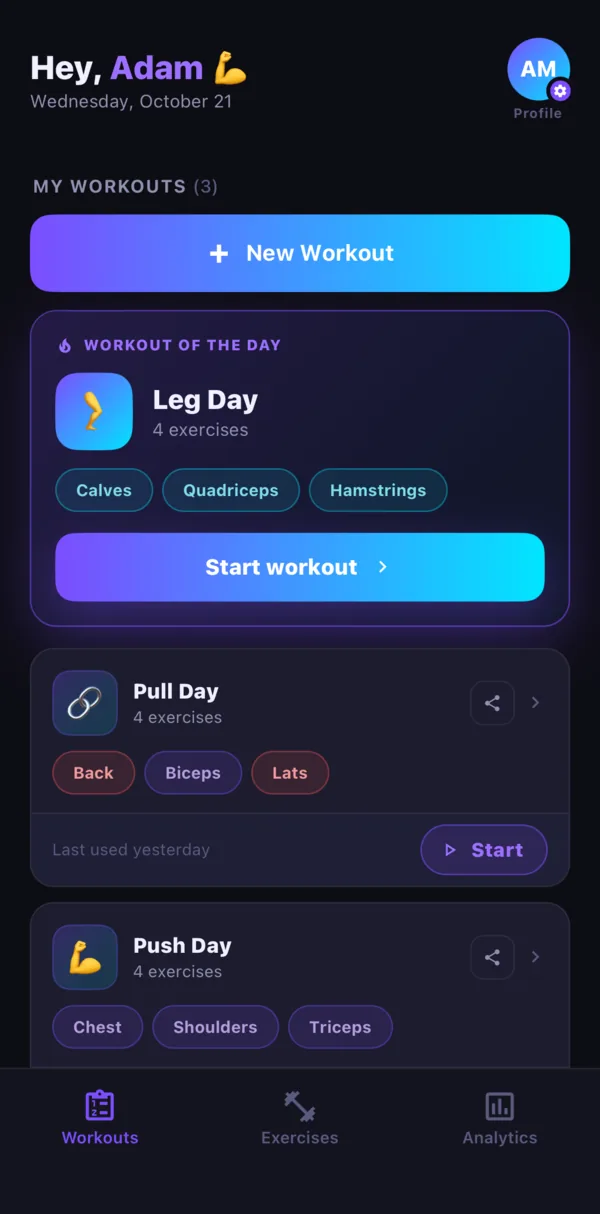
For a 3-day or 6-day split, give each workout its weekdays. A workout can also be scheduled after another workout, as in Legs after Pull day. The Workout of the Day card shows today's workout.
Each exercise opens with last session's sets filled in. Analytics → Muscle balance counts your sets per muscle group, giving each exercise to one group, as the tables here do. It shows the groups you haven't trained lately too.
What to do when you miss a session
On a fixed-weekday split, a missed Wednesday is just a missed Wednesday: resume on Friday as planned. Don't squeeze two sessions into one day.
On a rolling split, do the session that was next the day you come back, and carry on in order. That keeps the sets per muscle even over the cycle. A missed day pushes the whole calendar back by one day.
Check the total after a few weeks. If you keep missing the same session, say Legs on Fridays, move it to a day you do show up. For the weekly sets, see how to calculate training volume.