How Long Should a Workout Be? Add Up Your Sets and Rest
How long should a workout be? Our formula: half a minute per set plus the rest after it, plus a warm-up. A sample 18-set session with 90 seconds to 3 minutes' rest takes 56.5 minutes. In one 8-week trial, trained men's sessions of about 13 minutes built similar strength to 68-minute ones, but less muscle at three of four sites.
On this page
How long should a workout be? Add up sets and rest
Every working set costs two things: the time you spend lifting and the rest that follows it. Add your warm-up and you have the whole session. Here is the formula we use for every plan in this guide:
Our formula: session minutes = warm-up + working sets × (half a minute + the rest after each set).
Half a minute is about 10 reps at 3 seconds a rep, the tempo used in the trial in the next section (8 reps take 24 seconds, 12 take 36). The rest after an exercise's last set stands in for walking to the next station.
The 10-minute warm-up is our working number for a few lighter sets before the first lifts. If you change plates between sets or wait for equipment, count a full minute per set, as our upper lower split guide does. Each set then adds half a minute more.
Here is a sample full-body session worked out that way:
| Exercise | Working sets | Rest after each set | Minutes |
|---|---|---|---|
| Warm-up | none | none | 10 |
| Back squat | 3 | 3 min | 10.5 |
| Bench press | 3 | 3 min | 10.5 |
| Seated cable row | 3 | 2 min | 7.5 |
| Leg curl | 3 | 90 s | 6 |
| Biceps curl | 3 | 90 s | 6 |
| Triceps pushdown | 3 | 90 s | 6 |
| Total | 18 | 56.5 |
The squat row reads 3 sets × (0.5 + 3) = 10.5 minutes. So this session takes 56.5 minutes, and yours will land wherever your own sets and rests put it.
The rests follow the American College of Sports Medicine's position stand:
- Squat and bench, 3 minutes, within ACSM's advice of at least 2 to 3 minutes for core lifts with heavier loads.
- The row, 2 minutes, the top of the 1 to 2 minutes it recommends for muscle growth in novice and intermediate lifters.
- Single-joint lifts, 90 seconds, inside the 1 to 2 minutes it says may suffice for assistance exercises.
In one trial, extra minutes added muscle but not strength
In a 2019 study by Schoenfeld and colleagues, 45 trained men were randomly split into three groups, and 34 finished the 8 weeks. All did the same 7 exercises three times a week, 8 to 12 reps to failure, with 90 seconds between sets and about 2 minutes between exercises.
Only the sets per exercise differed, and the authors reported each group's average session time: about 13, 40 and 68 minutes.
| Sets per exercise | Sets per session | Minutes, as reported | Minutes, our formula |
|---|---|---|---|
| 1 | 7 | about 13 | 14 |
| 3 | 21 | about 40 | 42 |
| 5 | 35 | about 68 | 70 |
With 90 seconds after every set and no warm-up, our formula lands within 2 minutes of each reported time. Count the trial's 2-minute changes between exercises and it gives 17.5, 45.5 and 73.5 minutes, 4.5 to 5.5 more than reported. So it errs on the long side, which is the safe side for planning.
Squat and bench press 1RM rose in all three groups, and so did bench press endurance, with no significant difference between them.
Muscle size was different. Five sets grew the elbow flexors, the front of the thigh and the side of the thigh more than one set did. Triceps showed no difference, and three sets did not differ significantly from either.
A 2020 review of 6 studies agrees that one set builds strength, not that it builds the most. Its authors suggest a single hard set can produce significant squat and bench press gains in trained men.
Their dose: 6 to 12 reps at about 70 to 85% of 1RM, taken to failure, two or three times a week for 8 to 12 weeks. They call the gains suboptimal, yet significant.
Rest decides most of your session length
In the sample session, the 18 sets take 9 minutes of lifting. The rests take 37.5, two-thirds of the 56.5. Change the rest and the whole session moves with it:
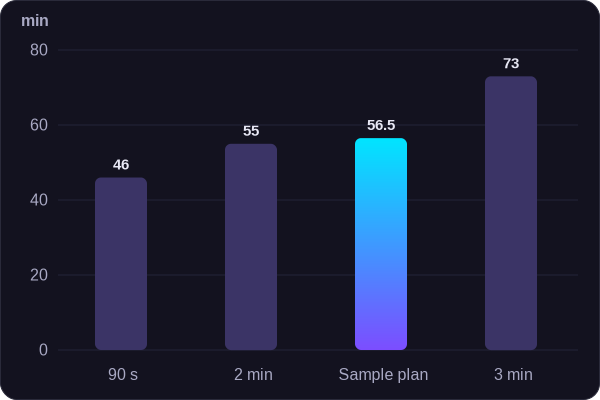
Rest alone spreads the same 18 sets from 46 minutes at 90 seconds, to 55 at 2 minutes and 73 at 3. So where you cut it matters.
For muscle growth, a 2024 meta-analysis suggested a small benefit to resting longer than 60 seconds and no appreciable difference beyond about 90. For strength, a review of 23 studies found trained lifters seemed to need more than 2 minutes to get the most gain.
So shorter rests cost little on curls and pushdowns, and more on heavy squats if strength is your goal. Our guide to how long to rest between sets goes lift by lift.
Common mistake: Timing your rests by feel. A rest that drifts from 2 minutes to 4 adds 36 minutes over 18 sets.
Time a week of sessions to find your real number
The formula is a plan. Your log shows what happens, so time one ordinary week before you change anything:
- Start the clock when you walk in, before your warm-up, and stop it after your last set.
- Log every working set as you go, weight and reps, as in how to log workouts.
- Compare each session with the formula after a week, using your planned sets and rests.
- Look at rests first, then at waits for equipment. Our working rule: dig in when a session runs more than 10 minutes over.
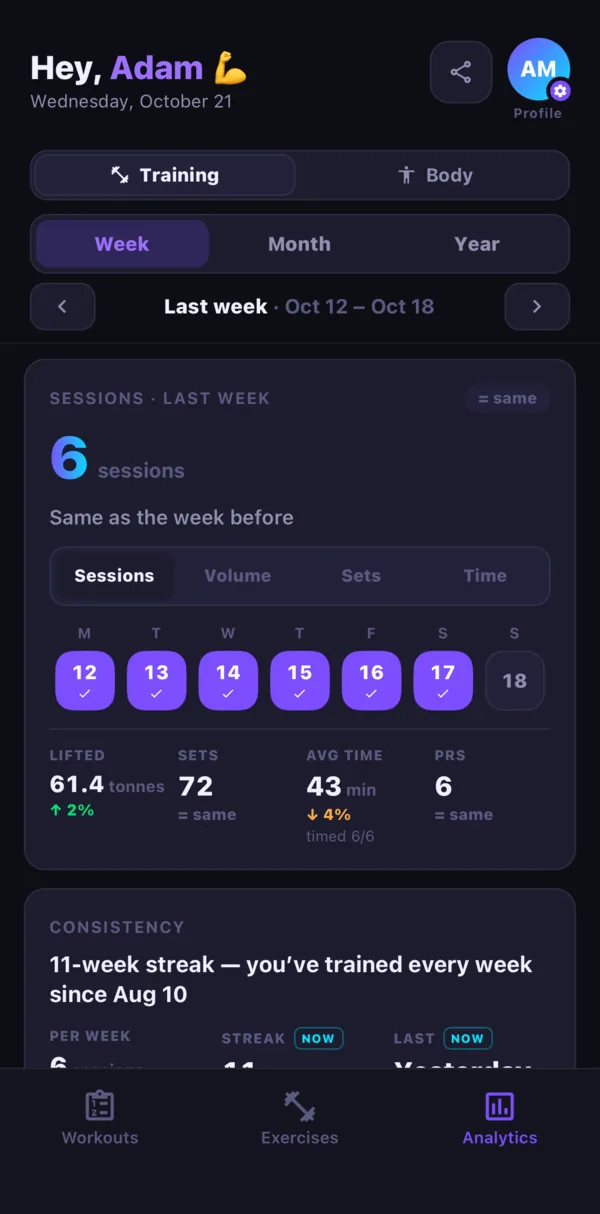
In Lifter Log, you press Start on the workout when you walk in and End after your last set.
If you forget, your second Save Sets in that workout on the same day starts the session, timed from your first save. Anything before that save is left out: the warm-up, and your first exercise too if you save its sets when you finish it.
Press Start when you walk in to include them. The Analytics tab shows your average session time for the week, month or year.
How to shorten a workout without cutting weekly sets
A 2021 review of time-efficient training suggests several ways to save time without losing volume. Three of them fit the formula.
- Superset the lighter lifts. A superset is two exercises for different muscles, back to back with little or no rest between them. The review says supersets roughly halve training time while keeping volume, in studies that paired opposing muscles.
- Keep the warm-up specific. When time is short, the review suggests skipping the general warm-up and stretching, and warming up only before the first exercise for each muscle group. Our guide to warm-up sets has ramps for that first lift.
- Move a lift to another day. The review rates weekly volume as more important than training frequency. For muscle growth, a 2019 meta-analysis found that with volume equal, training a muscle more or fewer times a week produced similar growth. For strength, the 2026 analysis below suggests gains rise with frequency.
The review adds that supersets are probably better for muscle than strength, and more tiring. For safety, it does not advise them for heavy free-weight lifts such as the squat and bench press. So in the sample session below, the squat and bench stay as straight sets, and each superset rests after the pair:
| Change | The arithmetic | Session minutes |
|---|---|---|
| As planned | From the first table | 56.5 |
| Row and leg curl as a superset, 2 min after each pair | 3 × (0.5 + 0.5 + 2) = 9, instead of 13.5 | 52 |
| Biceps curl and pushdown as a superset, 90 s after each pair | 3 × (0.5 + 0.5 + 1.5) = 7.5, instead of 12 | 47.5 |
| Arm superset moved to another day | The same 7.5 minutes, on that day | 40 |
Lifting time stays and each round still gets one full rest, so the two supersets save about a third of their time rather than half. All 18 sets stay in the week. If you are building a plan from a time limit instead, Lifter Log's AI program builder asks for your session length among its 10 questions.
When a longer workout is worth the time
Some goals need the extra minutes. Spend them on purpose:
- You want more muscle. In the 2019 trial, the 68-minute sessions grew more muscle than the 13-minute ones at three of four sites. A 2017 meta-analysis of 15 studies linked each extra weekly set per muscle to about 0.37% more growth.
- Your heavy sets need long rests. For heavy sets of 1 to 6 reps, ACSM suggests 3 to 5 minutes of rest for intermediate and advanced lifters. By our formula, 5 heavy triples on the squat with 4 minutes' rest take 5 × (0.5 + 4) = 22.5 minutes, 20 of them rest.
- You train on fewer days. The same weekly sets on three days make each day longer than on five. Our push pull legs guide sets out that trade.
Each extra set may give less back. In a 2026 analysis of 67 studies, gains in muscle and strength rose with weekly sets, and its models suggest each extra set adds less, more so for strength. Our guide to sets per muscle group per week covers how many to start with.