How to Stay Consistent at the Gym: Fixed Days, Short Gaps
To stay consistent at the gym, train on fixed days, keep the gap between sessions short and plan what you'll do when a day falls through. In check-in data from 30,110 gym members, 76% were less likely to go on a given day the longer it had been since their last visit.
On this page
How to stay consistent at the gym: five rules from research
Motivation comes and goes, so these rules work on your schedule. Each one links to the study behind it:
| Rule | What the study found |
|---|---|
| Train on the same weekdays | In gym check-in data, 69% of members were more likely to go on the weekdays they had gone before |
| Keep gaps short | In the same data, 76% were less likely to go the longer it had been since their last visit |
| Plan the when, and a backup | In a meta-analysis of 26 studies, if-then plans gave physical activity a small-to-medium boost, more so in studies where the plans covered barriers |
| Keep sessions doable | In a survey study of 111 new gym members, finding exercise less hard, feeling comfortable in the exercise setting and enjoying it each predicted habit growth, alongside exercising at a consistent time of day |
| Record every session | In a meta-analysis of 138 experiments, people prompted to monitor their progress were more likely to reach their goals |
The first two rules are patterns in attendance records. The gym study ran them through a prediction model, and its authors call the direction of these effects suggestive. The randomized evidence for a fixed routine comes from walking, in the next section.
So the plan is fixed days, short gaps, a backup for bad days, doable sessions and a log. The rest of this guide turns each one into something you can do this week.
Train on the same weekdays every week
Pick your days once and keep them. In the gym data, a streak of visits on the same day of the week predicted more attendance for 69% of members. In a survey study of new gym members, exercising at a consistent time of day was the strongest of four predictors of a growing habit.
Going often and going predictably are different things. In the gym data, how often members went and how predictable they were didn't line up.
A randomized trial tested a consistent routine on purpose, in walking rather than lifting. Ebert and Lin put 127 working, insufficiently active midlife adults into three groups for a 4-week planning program, then checked them again 4 weeks after it ended.
One group planned daily walks in the same context each day, one in varied contexts, and one made no plan. During the 4 weeks, both planning groups walked more than the group without a plan.
Only the same-context planners built a walking habit, measured as how automatic the walks felt, and they kept it at follow-up. Unexpectedly, they didn't keep up their extra walking after the program. Among people without a plan, those with a more routine daily schedule built more of a habit.
To use this, write your plan as one if-then sentence with a day, a time and a place. For example: "If it's Monday, Wednesday or Friday, I go to the gym straight from work."
For beginners, the American College of Sports Medicine recommends 2 to 3 days a week. Our guide to how many days a week to lift helps you pick your number.
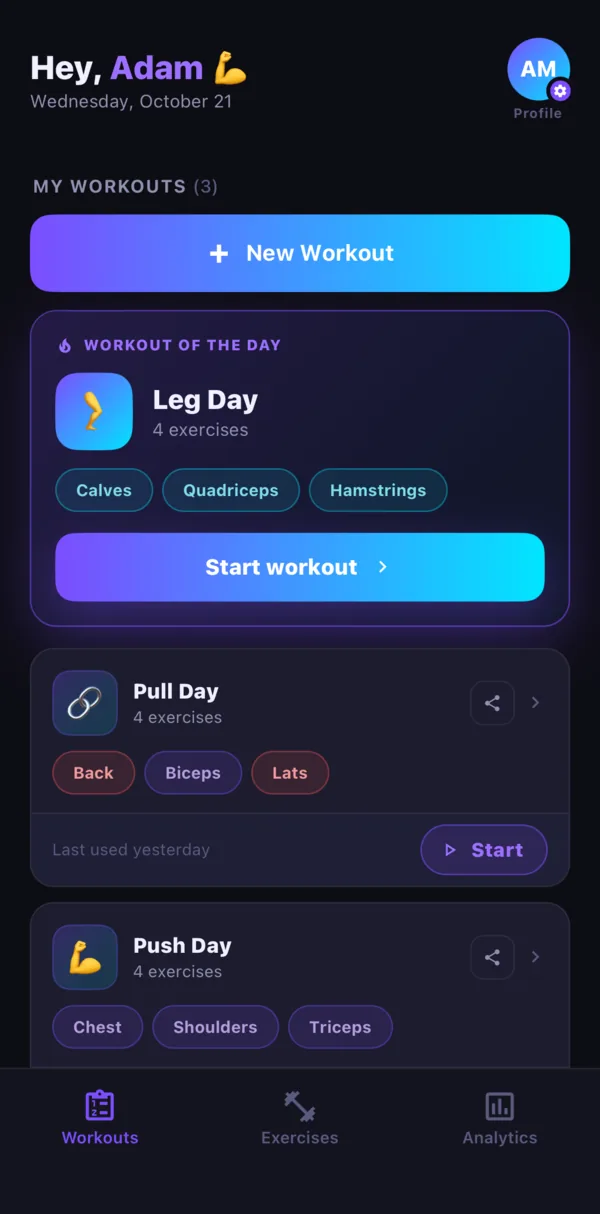
One caveat: Lifter Log's Workout of the Day card waits in the app and sends no reminder, so the if-then sentence is still yours to keep.
When you miss a session, keep the gap short
In a 12-week study of new daily habits, missing one opportunity lowered how automatic the habit felt only slightly and didn't materially affect how it formed. It tracked simple daily habits such as eating, drinking or activity, not gym sessions.
In the gym data, the time since the last visit was the strongest single predictor of whether a member went on a given day.
For 76% of members, a longer gap meant a lower chance of going. That is a pattern in attendance records, so it can't show that the gap itself causes the drop.
Here is our worked example. Two lifters plan Monday, Wednesday and Friday for 8 weeks, 24 sessions in all, and both finish 21:
| Week | Lifter A | Lifter B |
|---|---|---|
| 1 | 3 | 3 |
| 2 | 1 | 3 |
| 3 | 3 | 3 |
| 4 | 3 | 3 |
| 5 | 3 | 0 |
| 6 | 2 | 3 |
| 7 | 3 | 3 |
| 8 | 3 | 3 |
| Total | 21 of 24 | 21 of 24 |
| Longest gap | 5 days | 10 days |
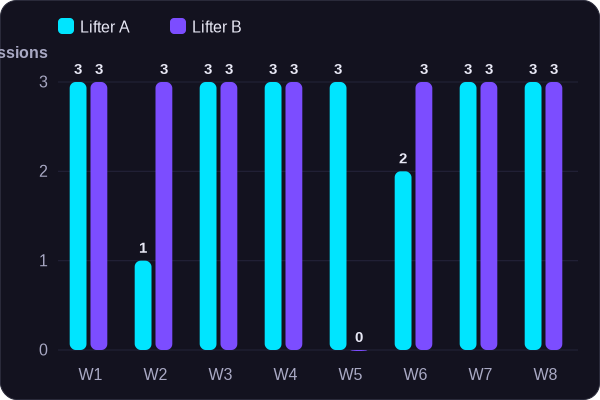
A misses Monday and Friday of week 2 but keeps the Wednesday, then misses a Wednesday in week 6, so no gap passes 5 days. B misses all of week 5, and Friday of week 4 to Monday of week 6 is 10 days.
On a normal week, the gaps are 2 or 3 days. Our working rule: when a week is going wrong, keep one session in it, even a short one. A's week 2 does exactly that. One session on Wednesday of week 5 would split B's 10 days into two gaps of 5, and B would finish 22 of 24.
Common mistake: Making up a lost week with double sessions. Our working rule: on fixed weekdays, go back on your next planned day with that day's workout. On a rotation, do the one you missed. Our push pull legs guide handles missed sessions the same way.
Write a backup plan and keep sessions doable
Decide now what you'll do when an ordinary problem knocks out a session: a late meeting, a short night or a busy gym.
In a meta-analysis of 26 studies, if-then plans gave physical activity a small-to-medium boost that was still detectable at follow-up. In a comparison between studies, the effect was stronger when the plans included ways to handle barriers. It measured physical activity in general, not lifting.
Across many kinds of goals, an earlier meta-analysis of 94 tests found a medium-to-large effect of if-then plans. Here are backup plans to copy, our own examples:
| If | Then |
|---|---|
| I'm kept late on a gym day | I do the first two exercises that evening or the next morning. If I can't, my next planned day goes ahead as normal. |
| I have only 25 minutes | I do the first two exercises, all their sets, and go home |
| The rack or bench I need is taken | I start the next exercise and come back to it |
| A busy week is coming | I pick the one session I will keep, and its day, now |
Keep the sessions doable. In Kaushal and Rhodes' survey study, exercising at a consistent time of day was the strongest predictor of a growing habit. Next came finding exercise less hard, feeling comfortable in the exercise setting and enjoying it. All four were self-reported. The authors advise trainers to keep exercises fun and simple for new clients.
For what a short session can hold, see how long a workout should be.
Typical habit times in these studies: 6 weeks to 3 months
Our reading of the four studies below: plan on two to three months, and longer for some people. Kaushal's 6 weeks came with four or more weekly bouts of exercise. Their numbers differ because each measured something different:
| Study and who | What it measured | Time it found |
|---|---|---|
| Kaushal and Rhodes, 2015: 111 new gym members at the start of a 12-week survey study | Habit, and moderate or strenuous leisure exercise, by survey | At least 4 exercise bouts a week, as members reported them, for 6 weeks was the minimum to establish an exercise habit. At week 6, 62% of those at four or more a week had reached the habit cut-off, and 45% of those below four; by week 12, 64% and 23% |
| Lally et al., 2010: 96 volunteers; the median comes from the 39 whose data fit the model well | How automatic a simple daily eating, drinking or activity habit felt | A median of 66 days, from 18 days to a projected 254 |
| Buyalskaya et al., 2023: 30,110 members of a North American gym chain with at least a year of check-ins | How predictable their check-ins became | About 2 to 3 months (68 to 78 days) for members the model fit well, after a correction |
| Singh et al., 2024: a review of 20 studies of health habits such as physical activity, diet and flossing; 2,601 people | Habit questionnaires and time to automaticity | In the 4 studies that reported a time (Lally's among them): medians of 59 to 66 days, means of 106 to 154 days, from 4 to 335 |
The gym-chain number changed after publication. The paper first put it at about 4 to 7 months, and Caltech's April 2023 news story said about six months.
In August 2023 the authors published a correction: about 2 to 3 months, or 68 to 78 days, for the members whose data fit their model well. The news story still says six months.
The other numbers have limits too. Lally's top value of 254 days is the model's projection past the 84 days the study observed. Exercise habits tended to take longer there, though the study wasn't powered to compare groups. In Singh's review, most studies had a high risk of bias.
Kaushal and Rhodes counted any moderate or strenuous leisure exercise. So on a 3-day lifting plan, one more weekly bout of other moderate or strenuous exercise would also have counted toward their four. Judge yourself by the weeks you kept.
Check planned against done once a week
Write down every session, then compare it with the plan. In a meta-analysis of 138 experiments with almost 20,000 people, those prompted to monitor their progress were more likely to reach their goals. The goals ranged across health and other areas, not lifting alone.
Effects were larger when progress was physically recorded, a comparison between studies rather than a direct test. These are our working rules for the check:
- Count sessions done against sessions planned, at the end of each week.
- Note the longest gap. On a 3-day plan a normal gap is 2 or 3 days. Keep every gap under a week.
- Write one line on each missed session, so your backup plans match the real reasons. A workout journal has room for it.
- Every four weeks, check that the plan fits. If you finished fewer days than planned in two of the four weeks, drop a day, as our days-per-week guide explains.
Run rule 4 on our example. A has one short week in each block of four (weeks 2 and 6). B has none in weeks 1 to 4 and one in weeks 5 to 8. Neither reaches two, so both keep three days. Rule 2 is what separates them: a 10-day gap for B against 5 for A.
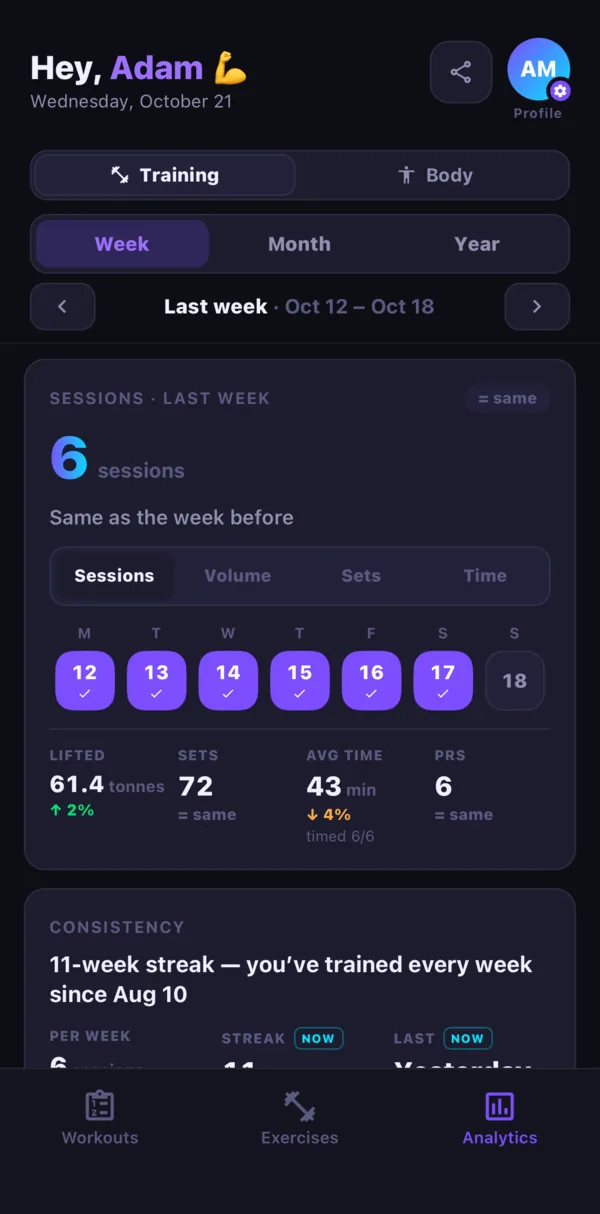
In Lifter Log, the Analytics tab keeps this count.
If you are starting from zero, our guide to how to start strength training has a three-day plan to put on your fixed days.