How Many Warm-Up Sets Should You Do? Ramps in kg and lb
How many warm-up sets you need depends on your working weight. Our working rule: 2 to 4 before the first barbell lift for a muscle, 0 or 1 before later or single-joint lifts. Stop at 70 to 80% of your working weight. For a 100 kg squat: 20 kg × 8, 40 × 5, 60 × 3, 80 × 2.
On this page
- How many warm-up sets: 2 to 4 for each muscle's first lift
- Make your last warm-up heavy, at 70 to 80%
- Warm-up ramps in kg and lb, with plates per side
- Do warm-up sets count? Leave them out of your log
- What six warm-up studies found, and what none tested
- When to do fewer warm-up sets, and before a 1RM test
- FAQ
How many warm-up sets: 2 to 4 for each muscle's first lift
A warm-up set is a lighter set of the same exercise, done before your working sets. Working sets are the ones your program counts and the ones you try to beat next week.
The number of warm-ups comes from one question: how far is it from the empty bar to your working weight? Our working rule covers that distance in three steps:
- Start with the empty bar for 8 to 10 easy reps. It counts as your first warm-up set.
- Add about a fifth to a quarter of your working weight each set, and do fewer reps each time, such as 5, then 3, then 2.
- Stop at about 70 to 80% of your working weight. Your next set is the first working set.
A light working weight is close to the bar, so the climb is short. A heavy one is far away, so it takes more steps. Because each step grows with the working weight, the rule tops out at about four sets.
| Situation | Warm-up sets, our rule | Example |
|---|---|---|
| A muscle's first lift, weight close to the bar | 2 | Overhead press, 40 kg |
| A muscle's first lift, moderate weight | 3 | Bench press, 185 lb |
| A muscle's first lift, weight far from the bar | 4 | Squat, 100 kg |
| Later lift, same muscles | 0 or 1 | Leg press after squats |
| Single-joint or machine lift | 0 or 1 | Leg extension, curls |
That count is our arithmetic. The studies below test something else: how heavy the last warm-up should be.
Make your last warm-up heavy, at 70 to 80%
The empty bar is practice for the movement. The heavier sets get you ready for the load, and they are what the research here tested. In a 2020 study of 40 trained men on a Smith machine, a single warm-up set at 40% of the working weight did worst overall, by the authors' reading.
The 14 squatters tried three warm-ups on separate days before 3 sets of 6 at 80% of their estimated max. After one set of 6 at 64% of max (80% of the working weight), working sets 2 and 3 moved faster than after one set at 32%.
In the squat, the two-set ramp did no better than that single heavier set. For the 26 who benched in the same study, the two-set ramp, 32% then 64%, beat the light set alone on two measures. The authors' verdict: "warming-up with few repetitions and low loads is not enough".
A 2015 systematic review of 31 upper-body trials points the same way. It found strong evidence that high-load dynamic warm-ups improve power and strength performance.
Heavy does not mean tiring. In the squat results, the authors suggest the single heavier set left less fatigue than the two-set ramp. Our rule aims to keep fatigue low another way: it cuts the reps as the weight climbs, to 2 or 3 on the last step.
Quick check: Your last warm-up should feel fast and easy, with plenty of reps left. If it felt like a working set, it was too heavy or too long.
In that study, warm-up sets were 1 minute apart, and the first working set came 3 minutes after the warm-up. After that, rest as you would between any working sets, as in our guide to rest between sets.
Warm-up ramps in kg and lb, with plates per side
Here are three ramps built with the rule, rounded to plates a gym has. Each one uses a 20 kg or 45 lb bar, and per side means the plates on each end.
| Set | Overhead press 40 kg | Bench press 185 lb | Squat 100 kg |
|---|---|---|---|
| Warm-up 1 | Bar 20 kg × 8 | Bar 45 lb × 10 | Bar 20 kg × 8 |
| Warm-up 2 | 30 kg × 3 (5 per side) | 95 lb × 5 (25 per side) | 40 kg × 5 (10 per side) |
| Warm-up 3 | 135 lb × 3 (45 per side) | 60 kg × 3 (20 per side) | |
| Warm-up 4 | 80 kg × 2 (20 + 10 per side) | ||
| Working sets | 40 kg (10 per side) | 185 lb (45 + 25 per side) | 100 kg (20 + 20 per side) |
The last warm-ups land at 75%, 73% and 80% of the working weight. The press needs only two warm-ups because the bar alone is already half of 40 kg.
In pounds, the classic plate-by-plate squat ramp lands close to the rule. For a 225 lb squat, warm up with 45, 95, 135 and 185 lb: the bar, then 25s, 45s, and a 45 and a 25 per side.
Deadlifts start from the floor with plates on. By our rule, the first set is the bar and a 20 kg or 45 lb plate a side: 60 kg or 135 lb. For a 140 kg deadlift, that gives 60 × 5, 85 × 3 and 110 × 2, with 32.5 and 45 kg per side for the last two.
Between warm-ups you only add plates. Going from 60 to 80 kg means 10 kg more on each side, the per-side math from our guide on how to load a barbell. For your own numbers, the plate calculator shows each side for any weight, and the 1RM percentage chart turns a max into working weights.
Do warm-up sets count? Leave them out of your log
Warm-ups get you ready for the working sets, and the working sets are what you compare from week to week. Logged with the working sets, they change some numbers and leave others alone. Here is the 100 kg squat session from the table, 3 sets of 5, logged both ways:
| Number | Working sets only | Warm-ups logged too |
|---|---|---|
| Sets | 3 | 7 |
| Total reps | 15 | 33 |
| Tonnage, weight × reps | 1,500 kg | 2,200 kg |
| Top-set weight | 100 kg | 100 kg |
| Estimated 1RM, best set | 116.7 kg | 116.7 kg |
The four warm-ups add 160, 200, 180 and 160 kg, so the session's tonnage grows by 700 kg, or 47%. In pounds, that is about 3,307 lb of work showing as 4,850. The top set and the estimate, worked out as weight × (1 + reps ÷ 30), stay put.
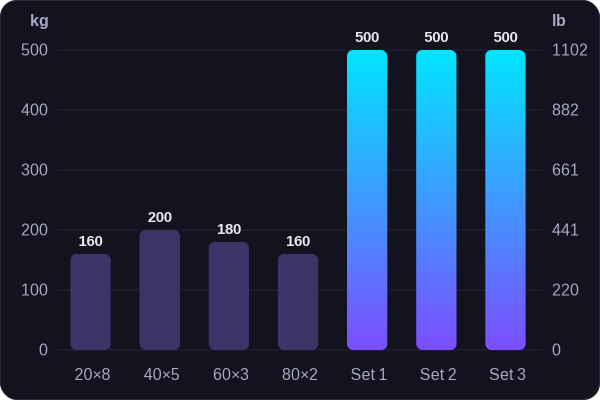
Squat twice a week and your quads show 14 sets instead of 6. That looks like plenty next to the weekly ranges in our sets per muscle guide, which counts working sets only.
So log the working sets and keep the ramp in your head. Your training volume and set counts then compare like with like from week to week, as tracking progressive overload needs.
What six warm-up studies found, and what none tested
The studies below tested warm-ups before lifting. Loads are a percentage of each person's one-rep max (1RM) unless a row says otherwise.
| Study, who | Warm-ups compared | What happened |
|---|---|---|
| Ribeiro 2014, 15 men | None, specific, aerobic or both, before 4 sets each of bench, squat and curl at 80% 1RM to failure | No difference in total reps |
| Souza 2024, 14 trained men, Smith machine | 8 reps at 45% for all, then nothing, 6 fast reps at 45% or 3 reps at 90% (10 minutes' rest), before 3 sets of squats at 75% to failure | No difference in total reps; more volume on the first set after the 90% set than after the 8 reps alone |
| Ribeiro 2020, 40 trained men aged 19 to 30 (14 squat, 26 bench), Smith machine | 6 reps at 32% of estimated max, 6 at 64%, or both, before 3 sets of 6 at 80% | Squat: faster bar in sets 2 and 3 after the 64% set than the 32% set. Bench: the two-set ramp beat the 32% set on two measures |
| Abad 2011, 13 trained people | 8 reps at about 50% and 3 at about 70% of estimated max, with or without 20 minutes on a bike at 60% of max heart rate first | Leg-press 1RM 8.4% higher on average with the bike |
| Barroso 2013, 16 strength-trained men | 5 or 15 minutes of general warm-up at 40% or 70% of VO2max, before a leg-press max | 15 minutes at 40%: about 3% higher than the rest. 15 minutes at 70%: about 4% lower |
| Lisboa 2024, 57 trained women aged 60 and over | One 45-second set at 30 to 50% of the working weight, stretching, or nothing, before 4 single-joint exercises to failure in an 8-exercise session | The warm-up set cut reps on triceps pushdowns and preacher curls, and did not raise them on leg extensions and leg curls, where stretching did |
Read together: in one study's squat arm, a heavier warm-up set gave faster working sets, and in two leg-press studies a general warm-up changed a heavy single. Before sets taken to failure, two trials found no difference in total reps between warm-ups, and one found fewer reps after a light set.
None of these trials compared two warm-up sets with four. The ones that describe their specific warm-up used one or two sets, so the counts in this guide are our working rule, built on their loads.
When to do fewer warm-up sets, and before a 1RM test
The rule assumes a cold start on a barbell lift. Change it when the start changes:
- Later lifts for the same muscles: after a 100 kg squat, our rule gives the leg press one light set or none, since the squat already trained the same muscles.
- Single-joint and machine lifts: one light set at most, by our rule. In the Lisboa study, women aged 60 and over did curls and pushdowns inside an 8-exercise session. A 45-second light set before them cut reps, in a group the other trials did not include.
- Light or high-rep days: the working weight is closer to the bar, so the rule gives fewer steps on its own.
- A 1RM test: in Abad 2011, the specific warm-up before the max was two sets, 8 reps at about 50% and 3 at about 70%. In the two leg-press studies, a general warm-up raised the max at 60% of max heart rate for 20 minutes, or 40% of VO2max for 15. At 70% of VO2max for 15 minutes, it lowered the max. Our guide on how often to test your 1RM covers when a test is worth it.
Common mistake: Turning the warm-up into a workout. Ten reps at every step on the way to a set of 5 is a session before the session. Our rule keeps the reps falling as the weight climbs.