How to Keep a Workout Journal: What to Write and Review
To keep a workout journal, write three layers: the numbers for every set (exercise, weight, reps), one short line only when a set surprised you, and a two-minute review each week. In the six-week example below, a drop from 24 to 18 total bench reps was a heavier bar plus one short night, not a stalled program.
On this page
A workout journal has three layers
Writing down everything is a lot to keep up, and long templates are easy to abandon. Three layers, each with a different cost, keep it small enough to survive.
| Layer | What you write | When | Time |
|---|---|---|---|
| 1. Numbers | Exercise, weight and reps for each set | Right after each set | A few seconds a set |
| 2. Context | One line on why a number surprised you | Only when it did | One sentence |
| 3. Review | What went up, what didn't, what you'll change | Once a week | About two minutes |
The first layer is the whole workout log, and it comes first because the other two are useless without it. A note saying "slept badly" means nothing if you can't see what the bench did that day.
Writing progress down also has some research behind it. Across 138 experiments, people prompted to monitor their progress were more likely to reach their goals, and the effect was larger when the information was physically recorded (Harkin et al., 2016). The recording comparison is across studies, and the goals were not all about lifting.
Set up a workout journal page before you train
A journal page needs five columns, and you can rule them in a notebook in a minute: date, exercise, weight, reps per set, note. Fill in the first three before the session, using last time's numbers as today's target.
| Date | Exercise | Weight | Reps per set | Note |
|---|---|---|---|---|
| Tue 3 Nov | Barbell bench press | 80 kg (176 lb) | 8, 8, 7 | Last rep slow |
| Tue 10 Nov | Barbell bench press | 80 kg | _, _, _ (target 8, 8, 8) |
The second row is how a page looks at the start of a session. The target sits in pencil, and you replace it with what happened. Per-set conventions for dumbbells, plates and machines are in how to log workouts, so this guide skips them.
Leave the note column empty by default. An empty note means the session went as expected, which is information too.
Write a context line only when a number surprises you
The context layer is where journals go wrong, in both directions. People either write a paragraph after every set or write nothing and forget why a session went badly. One rule fixes both: if you can't explain a number from the last session, write one line about it.
Good lines state something you observed. They stay short and can be checked later:
- The set itself: "last rep slow", "grip slipped on set 3", "stopped with form breaking".
- The day: "5 h sleep", "trained fasted", "gym packed, rested 90 s instead of 3 min".
- The setup: "different bench", "new shoes", "used the 15 kg bar".
- A cue for next time: "elbows tucked on the way down".
- A tweak: "left shoulder pinched on set 2". If it keeps showing up, see a qualified professional.
Common mistake: Rating every set "felt easy" or "felt hard". In an exploratory meta-analysis of 12 studies, people predicting how many reps they had left before failure underestimated by about one rep on average, with large differences between studies (Halperin et al., 2022). A feeling rating is a different measure, but nothing checks it either, so write what you observed, such as "last rep slow".
A six-week bench journal: what the notes explain
Here is what the three layers look like on one lift. It is an example, not data from a study. The lifter benches once a week, hits 8, 8, 8 at 80 kg and moves up to 82.5 kg in week 3.
| Week | Weight | Reps per set | Total reps | Note |
|---|---|---|---|---|
| 1 | 80 kg (176 lb) | 8, 8, 7 | 23 | Last rep slow |
| 2 | 80 kg | 8, 8, 8 | 24 | |
| 3 | 82.5 kg (182 lb) | 7, 6, 6 | 19 | New weight |
| 4 | 82.5 kg | 7, 6, 5 | 18 | 5 h sleep |
| 5 | 82.5 kg | 8, 7, 6 | 21 | 8 h sleep |
| 6 | 82.5 kg | 8, 8, 7 | 23 |
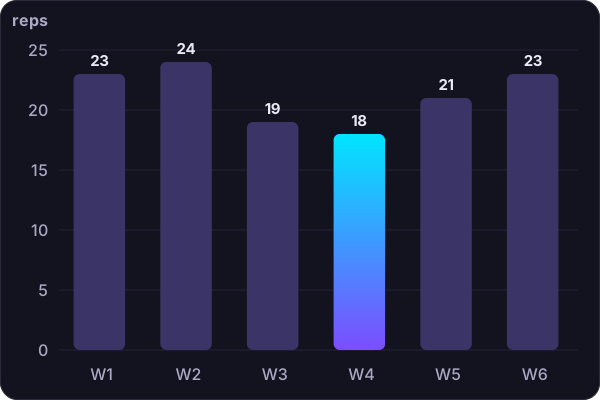
Read weeks 3 and 4 without the notes and it looks like a stall: total reps fell from 24 to 19, then to 18. The tempting fix is to drop back to 80 kg or rewrite the program.
With the notes, the picture changes. Week 3's dip has a reason (a heavier bar), and week 4's one extra lost rep has a note too (5 h sleep). Week 5 recovers with 8 h sleep, and week 6 gets within a rep of the 80 kg total.
In this example the journal changed the decision: the notes showed a short night and a heavier bar, not a broken program.
Do a two-minute review once a week
The review turns a diary into a training tool. Do it on the same day each week, ideally right after your last session, and answer three questions in order:
- Did a main lift go up? Look at weight, reps per set or total reps against last week. Any of the three counts.
- If not, what do the notes say? A short night, a missed meal or a new bench explains a bad week. An empty note column on a flat week is a hint to check the program.
- What is next week's target? Write it in pencil on next week's row. Same weight with one more rep, a small jump (see double progression), or the same session again after a bad night.
Treat one bad week as noise. As a working rule, not a research finding, if a lift stays flat for three weeks and the notes offer no reason, move to how to break a strength plateau. If the notes keep saying tired, sore and slow across several lifts, a deload week is the next thing to read.
If size is your goal, you can add a monthly line for tape measurements. How to track body measurements covers where to measure and how to keep the readings comparable.
Choose paper, phone notes or an app by what you will open
All three work, and the right one is the one you open every session. A paper notebook costs nothing and has no notifications. A phone is faster between sets and can show a trend. The tradeoff most people hit is that paper has no charts, so the weekly review means flipping pages and adding up reps by hand.
A practical split: log the numbers where entry is fastest and charts build themselves. Write the one-line why wherever you will see it next week, such as a notebook margin or your phone's notes app.
Moving an old paper log is a smaller job than it sounds: Lifter Log's AI import reads photos, spreadsheets, PDFs and CSV exports from other apps. For the full comparison, see the spreadsheet guide and how to track progressive overload.