1RM Percentage Chart: Reps and Weights in kg and lb
A 1RM percentage chart shows how many reps you can do at each percentage of your one-rep max. A 2024 meta-analysis of 269 studies estimates about 5 reps at 90%, 10 at 80%, 15 at 70% and 20 at 60%, give or take 2 to 4 reps. Multiply your max by the percentage to get the weight.
On this page
The 1RM percentage chart: reps at each percentage
Each row tells you how many reps one fresh set to failure usually allows at that load. The averages come from Nuzzo et al. (2024), who pooled 952 rep tests by 7,289 people from 269 studies. The textbook column is the older NSCA chart (8 reps at 80%), as the same paper reprints it.
| % of 1RM | Textbook | 2024 average | Typical range (±1 SD) | Bench |
|---|---|---|---|---|
| 95% | 2 | 3.3 | 2–5 | 2.6 |
| 90% | 4 | 4.9 | 3–7 | 4.1 |
| 85% | 6 | 7.2 | 5–9 | 6.2 |
| 80% | 8 | 9.8 | 7–12 | 8.8 |
| 75% | 10 | 12.4 | 9–15 | 11.5 |
| 70% | 11 | 14.8 | 11–18 | 14.1 |
| 65% | 15 | 17.1 | 13–21 | 16.6 |
| 60% | Not listed | 19.5 | 15–24 | 19.3 |
The typical range is the average plus or minus one standard deviation between people, our arithmetic from the paper's own table. Bench is the paper's separate average for the bench press; use it for that lift. The authors suggest the general average for other lifts, except the leg press, which runs higher (about 13 reps at 80%).
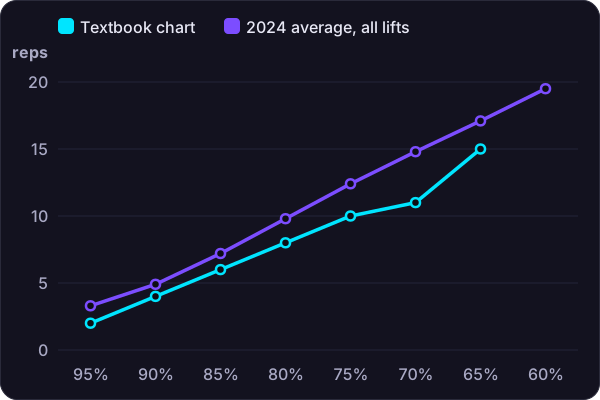
- Heavy loads are close. From 85% to 95%, the two sit about 1 rep apart. At 90%, the textbook says 4 reps and the 2024 average is 4.9.
- Lighter loads aren't. At 70%, the textbook says 11 and the average is 14.8, almost 4 reps apart.
- People spread out at light loads. The standard deviation is 2.5 reps at 80% but 4.4 at 60%. The paper's analysis suggested little effect of sex, age or training status.
The 1RM calculator uses the Epley formula for its reps column: 8 reps at 80% and 13 at 70%. That's about 2 reps under the 2024 averages at both loads, a reminder that every column is an estimate.
Turn a percentage into weight on the bar
Multiply your max by the percentage, then round to the nearest jump your plates allow. With 1.25 kg plates on each side, that's 2.5 kg. With 2.5 lb plates, it's 5 lb.
Here it is for a bench press max of 102.5 kg (226 lb):
| % of 1RM | Exact weight | Load in a kg gym | Load in a lb gym |
|---|---|---|---|
| 95% | 97.4 kg | 97.5 kg | 215 lb |
| 90% | 92.3 kg | 92.5 kg | 205 lb |
| 85% | 87.1 kg | 87.5 kg | 190 lb |
| 80% | 82.0 kg | 82.5 kg | 180 lb |
| 75% | 76.9 kg | 77.5 kg | 170 lb |
| 70% | 71.8 kg | 72.5 kg | 160 lb |
| 65% | 66.6 kg | 67.5 kg | 145 lb |
| 60% | 61.5 kg | 62.5 kg | 135 lb |
Don't sweat the rounding. It moves the load by half a jump at most, 1.25 kg or 2.5 lb, about 1.2% of this max. In the 2024 averages, each 5% you add between 60% and 90% costs 2 to 3 reps. So rounding by about 1.2% is worth about half a rep, well inside the typical range.
To work out which plates go on each side, use the plate calculator, or follow the steps in how to load a barbell.
Heavier percentages for strength, a wide range for muscle
Heavier loads build the most 1RM strength. ACSM starts novices lighter, at 60–70%, and moves advanced lifters to 80–100%. For muscle size, the load matters less, at least when sets go to failure. Here are the ranges in the American College of Sports Medicine's position stand (ACSM, 2009):
| Goal | Who | % of 1RM | Reps per set |
|---|---|---|---|
| Strength | Novice to intermediate | 60–70% | 8–12 |
| Strength | Advanced | 80–100%, cycled | Mostly heavy; see below |
| Muscle size | Novice to intermediate | 70–85% | 8–12, for 1–3 sets |
| Muscle size | Advanced | 70–100% | 1–12, for 3–6 sets, mostly 6–12 |
| Muscular endurance | Novice to intermediate | Relatively light | 10–15 |
| Muscular endurance | Advanced | Lighter, varied | 10–25 or more |
| Power | Any level, alongside strength work | 30–60% upper, 0–60% lower body | 3–6, lifted fast, not to failure |
For intermediate to advanced lifters, ACSM's summary also recommends loads you could lift 1 to 12 times. Over time, the emphasis moves to heavy loads you could lift only 1 to 6 times. Its text adds that experienced lifters seem to need at least 80% of 1RM for further strength gains.
For endurance, its summary gives 40–60% for more than 15 reps, with short rests.
Lighter loads can still build muscle. A meta-analysis of 21 studies compared loads of 60% or less with heavier ones, with every set taken to failure. Muscle growth was similar. Heavy loads built more 1RM strength (Schoenfeld et al., 2017).
Once you have a percentage, you still need a rep range that fits your weight jumps. Double progression shows how to pick one.
Why your reps won't match the chart exactly
The chart is an average of thousands of people doing one fresh set. Your number moves with four things:
- The lift. At 80%, the estimates were about 13 reps on the leg press and about 9 on the bench press (Nuzzo et al., 2024). In a smaller study, men did more reps on the back squat than on the bench press or curl at 60%, with smaller gaps at 80–90% (Shimano et al., 2006).
- You. Two lifters with the same max can be several reps apart at 70%. The spread is widest at light loads.
- Rest and set number. The chart covers a first set. In one study, shorter rests cost reps over four sets of squat and bench (Willardson and Burkett, 2005). Keep your rest the same so your sets compare.
- Failure. The chart counts reps to failure. If your working sets stop short of failure, expect fewer reps than it shows.
So read the chart as a first guess, most reliable at heavy loads. Your own log is the better guide for the lifts you do every week.
Check your max with one set at 80%
A max from last spring makes every percentage wrong by the same share. If your real max is now 96 kg, not 102.5 kg, every load in the table is about 7% too heavy. One set catches it.
- Load 80% of the max you plan from. For the 102.5 kg bench, that's 82.5 kg (180 lb).
- Do one set to failure, the way the chart was measured. Use a spotter or safety bars, and count only reps with good form.
- Compare with the bench row. The average at 80% is about 9 reps. The paper's spread gives a typical range of 7 to 11. For other lifts, use the general 80% row: about 10 reps, typically 7 to 12.
| Reps at 82.5 kg (bench) | What it suggests | What to do |
|---|---|---|
| 6 or fewer | Your max is probably out of date and too high | Re-estimate from that set. At 5 reps: 82.5 × (1 + 5 ÷ 30) = 96.3 kg (212 lb) |
| 7–11 | The max fits | Keep it |
| 12 or more | You've probably got stronger, or you get more reps than average | Re-estimate from a heavier set. For example, 92.5 kg × 5 gives 107.9 kg (238 lb) |
This is our rule of thumb built on the 2024 table, not a tested protocol. The re-estimates use Epley, the formula behind the calculator and the app's estimate. The third row uses a heavier set because estimates are probably rougher past 10 reps, which the wider spread at light loads points to.
Common mistake: borrowing the max from a different version of the lift. A paused bench, a close grip or a high-bar squat is a different lift with its own max.
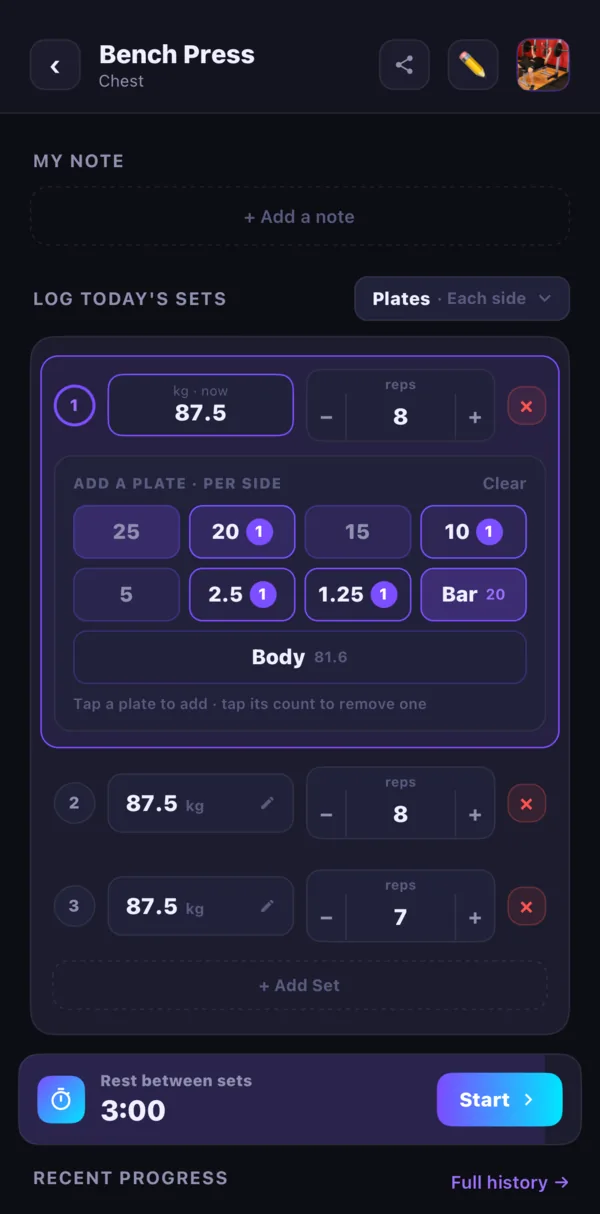
Your log can give you the same answer without a test set. Any hard set of up to 10 reps carries an estimate of your max. In the app's Analytics tab, the estimated 1RM for each lift is worked out from your logged sets.
A session of only easy sets gives a low estimate, so watch the trend, not one point. For the rest of the tracking picture, see how to track progressive overload.