How to Read InBody Results and Tell If a Change Is Real
To read InBody results, start with weight, skeletal muscle mass and body fat mass, and compare each with your last scan on the same machine. Trust a change only when it beats the normal day-to-day spread: about 1 kg for muscle and 1.5 kg for fat. A scale down 0.4 kg can hide 1.6 kg of fat lost.
On this page
How to read InBody results: the three numbers first
Of the dozens of values on an InBody sheet, three carry the story for a lifter. They sit together in the Muscle-Fat Analysis bars near the top:
- Weight. The same number a scale shows. On its own, it can't tell you what changed.
- Skeletal muscle mass (SMM). The muscle attached to your bones, the kind your training builds. It is part of your lean mass, not all of it.
- Body fat mass. Your fat in kilograms. Percent body fat, printed further down, is this number divided by your weight.
Each bar is drawn against the average for people of your height and sex, which the sheet marks as 100% (InBody's guide to the sheet). A muscle bar at 110% means 10% above that average. That compares you with other people. It says nothing about whether you're improving.
InBody also names the shape the three bars make. When the muscle bar reaches past both the weight and fat bars, it's a D shape. When it falls short of both, it's a C shape, and when all three roughly line up, an I shape.
The top block of the sheet splits your weight into water, protein, minerals and fat, which add up to your weight. Everything that isn't fat is your fat-free mass, also called lean mass.
On your first scan, there's nothing to compare yet. Note the three numbers and the shape, then book the next scan for about 8 weeks later, under the same conditions.
What changed between two scans: a worked example
Here are two InBody scans of the same lifter, 10 weeks apart, on the same machine at the same time of day. The numbers are an example, sized to match what research describes for 10 weeks of lifting.
| Number | Scan 1 (week 0) | Scan 2 (week 10) | Change |
|---|---|---|---|
| Weight | 82.0 kg (180.8 lb) | 81.6 kg (179.9 lb) | −0.4 kg (−0.9 lb) |
| Skeletal muscle mass | 36.5 kg (80.5 lb) | 37.2 kg (82.0 lb) | +0.7 kg (+1.5 lb) |
| Body fat mass | 17.2 kg (37.9 lb) | 15.6 kg (34.4 lb) | −1.6 kg (−3.5 lb) |
| Percent body fat | 21.0% | 19.1% | −1.9 points |
Read it in three steps:
- Check the scale first. Down 0.4 kg in 10 weeks. On its own, that looks like nothing happened.
- Split the change. Fat fell 1.6 kg while weight fell only 0.4 kg, so lean mass rose 1.2 kg. Skeletal muscle accounts for 0.7 kg of that.
- Read it next to your training log. If muscle went up, check that your main lifts moved too, because your log explains what the sheet shows. See how to log workouts and how to track progressive overload.
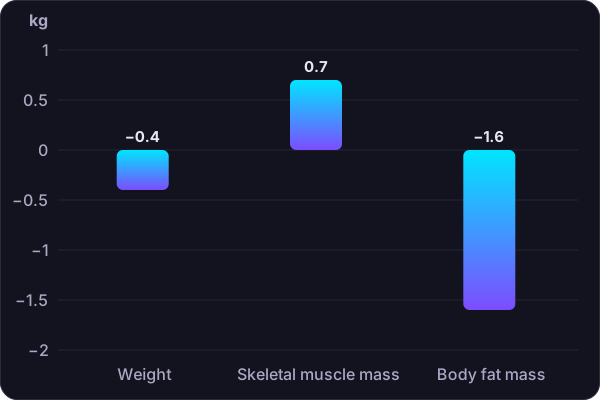
That pattern fits one review of resistance training. It says 10 weeks of lifting may add about 1.4 kg (3 lb) of lean weight and remove about 1.8 kg (4 lb) of fat (Westcott, 2012). That's why the scale may barely move.
It's a single-author review that mostly describes people starting or restarting training, so treat it as a ballpark.
Changes under 1 kg of muscle or 1.5 kg of fat can be noise
Before you celebrate 0.7 kg of muscle, check how much your readings wobble from day to day. In a lab study of the InBody 770, 14 fit adults were scanned twice on each of five visits over three weeks (Looney et al., 2024).
Every visit was at the same time of day, after 10 hours without food and 48 hours without hard exercise. The machine repeated itself within about 0.2 kg on the same day.
Across all ten scans, though, each person's skeletal muscle reading spread over about 1.0 kg on average, from lowest to highest, and their body fat mass over about 1.5 kg.
Your gym's conditions are looser than a lab's, so treat that spread as the smallest margin worth trusting:
Quick check: believe a muscle change of more than 1 kg (2.2 lb) or a fat change of more than 1.5 kg (3.3 lb). Smaller than that, wait for the next scan to move the same way.
Apply it to the example:
- Fat, down 1.6 kg: just past the margin. A good sign, but confirm it on the next scan.
- Muscle, up 0.7 kg: inside the margin. Promising, but unconfirmed.
- Weight, down 0.4 kg: noise. In the same study, each person's weight readings spread over about 1.7 kg.
The same margins tell you how often to scan. At the review's pace of 1.8 kg in 10 weeks, fat takes about 8 weeks to clear 1.5 kg.
Muscle is slower, because skeletal muscle is only part of the review's 1.4 kg of lean gain. At the example's pace of 0.7 kg in 10 weeks, it would take about 14 weeks to pass 1 kg.
So a scan every 8 weeks or so suits fat, and muscle is best judged across two or three scans. If you've trained for years, give it longer.
Scan the same way every time
A change between two scans is only about you if the conditions match. You don't need lab rules, but copy their idea and keep everything the same:
- Same machine. Use the same device every time, ideally at the same gym or clinic.
- Same time of day. First thing in the morning is the easiest to repeat.
- Same food and drink routine. Before breakfast is simplest. If you eat first, eat the same thing.
- Before training, or on a rest day. The lab study above kept people away from hard exercise for 48 hours.
- Bathroom first, then bare hands and feet. InBody also asks you to stand for five minutes before the test and to keep your arms and legs from touching during it (InBody's testing tips).
You may not need to fast. In one study, a 400 kcal breakfast changed estimated fat-free mass by 0.2 kg at most on average, on a different type of impedance scale (Korzilius et al., 2023). The bigger risk is changing your routine between scans.
Common mistake: scanning after a workout one month and before breakfast the next. Then you can't tell which part of the change is you and which part is the routine.
InBody and DEXA numbers don't line up
If you have both an InBody and a DEXA scan, don't compare them with each other. In a study of 1,000 healthy active-duty US Marines tested in everyday conditions, the InBody 770 read body fat lower than DEXA on average (Potter et al., 2025).
The gap was about 4 percentage points in men and 3 in women. Fat-free mass read higher, by 3.4 kg in men and 2.0 kg in women.
The gap also varied from person to person, so you can't convert one number into the other by adding a fixed amount. A lifter at 18% on InBody who books a DEXA could see a higher number without gaining any fat.
Both machines were highly repeatable, which is what tracking needs. The authors add that the InBody readings were less accurate and consistent in these everyday conditions than under tight lab control, so your routine still matters.
Compare InBody with InBody and DEXA with DEXA. If you switch, treat the first scan on the new machine as a fresh starting point.
The rest of the sheet: score, segments and visceral fat
- InBody Score. InBody describes it as a simplified score of your overall body composition, made for tracking change (InBody). Use it that way: compare it with your last score, taken in the same conditions.
- Segmental Lean Analysis. Lean mass in each arm, each leg and your trunk. The top bar compares each segment with the expected amount for your height and sex, and the bottom bar compares it with your body weight. Use it to compare left with right, and each limb with your last scan. The 1,000-person study found limb readings less accurate and reliable, so trust a left-right gap only if it repeats across scans.
- Visceral fat level. InBody's estimate of the fat around your organs. The authors of the 1,000-person study found it didn't match DEXA and may be no better than a simple waist measurement. Read it as a rough trend, and measure your waist too.
- ECW/TBW ratio and the research rows. These describe your body water and give estimates such as your basal metabolic rate. If the sheet flags one of them, ask a doctor or another qualified professional. It isn't a training number.
Each scan's detail view in Lifter Log adds lean mass per limb, visceral fat and a left-right balance card, so you can compare your sides from scan to scan. You can also log tape measurements such as your waist, and how to track body measurements explains how to repeat them. The body-scan section shows what else it reads.